
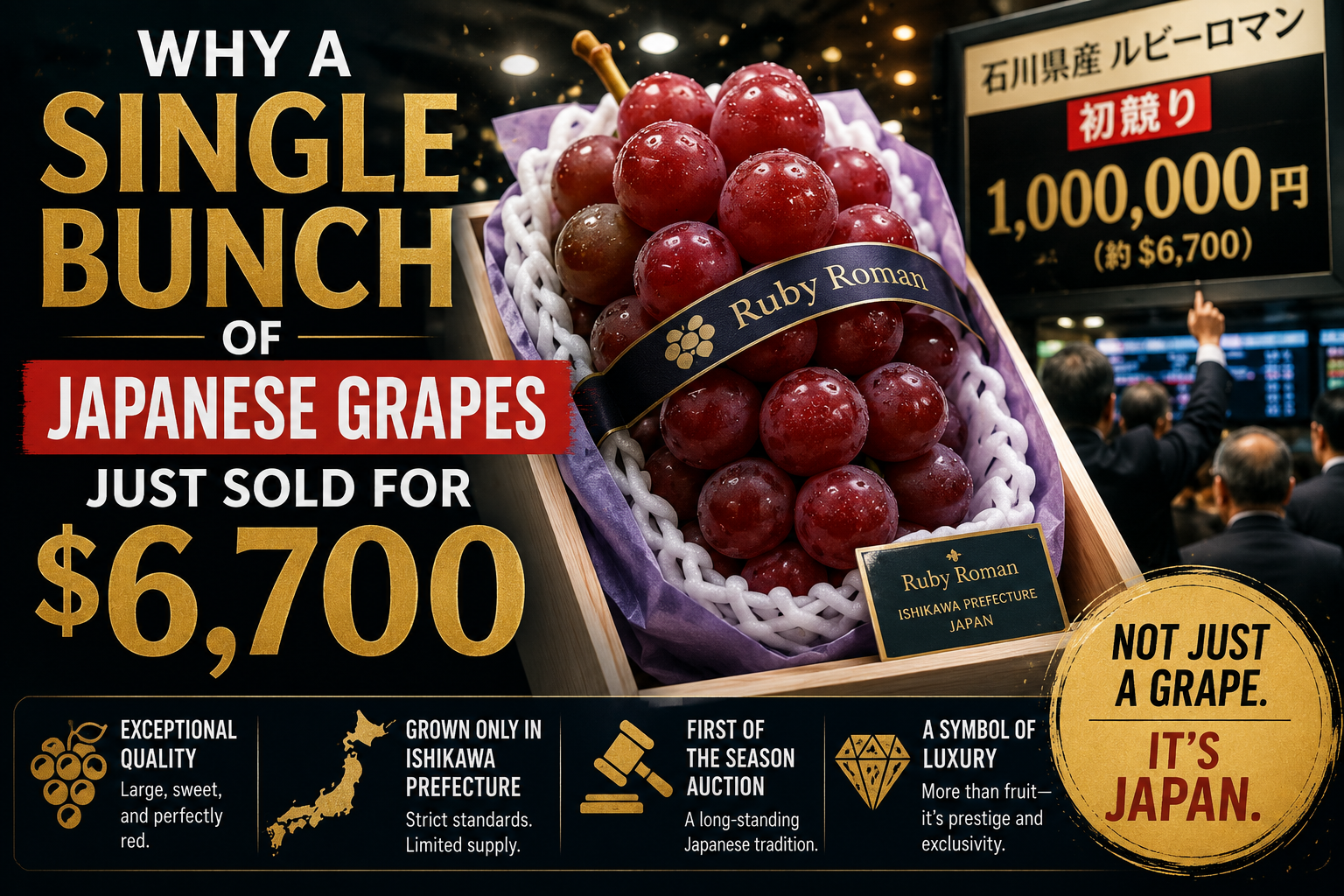
At Kanazawa’s first grape auction of the season, a single bunch of Ishikawa Prefecture’s premium Ruby Roman grapes sold for 1 million yen — roughly $6,700 — putting the price of each individual grape at about 30,000 yen ($200). If that sounds absurd for fruit, that’s rather the point. Japan’s luxury fruit market runs on its own logic, and Ruby Roman sits near the very top of it.
What Is Ruby Roman, Exactly?
Ruby Roman is a proprietary grape variety developed by Ishikawa Prefecture over 14 years of selective breeding, first released commercially in 2008. It’s not just marketing — the prefecture enforces strict quality standards before any bunch can be sold under the Ruby Roman name. Each grape must weigh at least 20 grams (roughly the size of a ping pong ball), reach a minimum sugar content of 18%, and display a deep, uniform ruby-red color. Bunches that don’t meet the standard are sold as ordinary grapes at a fraction of the price, which is part of why the certified fruit commands such a premium.
This kind of provenance protection is becoming more common across Japan’s agricultural exports as prefectures compete for both domestic prestige and, increasingly, international buyers. Ruby Roman’s export volume remains small — most of the harvest stays within Japan — but limited shipments have started reaching luxury retailers in Hong Kong, Singapore, and Taiwan in recent years, part of a broader trend of Japanese prefectures marketing regional agricultural products as premium exports rather than just domestic specialty goods.
The Story Behind the Name
Unlike many premium fruit varieties that spread to multiple growing regions over time, Ruby Roman is legally restricted to cultivation within Ishikawa Prefecture alone. Farmers must be certified by the prefectural agricultural cooperative, and every bunch is inspected before it can be sold under the name. This exclusivity is deliberate: by keeping supply limited and quality strictly enforced, Ishikawa has turned a grape variety into a genuine regional brand, similar to how Champagne or Kobe beef carry legal protections tied to their place of origin. The name itself was chosen through a public naming contest in 2007, drawn from the grape’s deep ruby color and Ishikawa’s ambition to make it a variety with international, “Roman” (romantic) appeal.
Why the First-of-Season Price Is So Extreme
The million-yen bunch wasn’t really a market price — it was a hatsuseri, the ceremonial first auction of the season. This is a long-standing tradition across Japan’s produce markets, not unique to grapes: the same phenomenon happens with the season’s first tuna at Toyosu Market and the first Yubari melons in Hokkaido. Buyers at these auctions are almost always businesses — department stores, luxury hotels, or gift retailers — competing for the publicity of owning the season’s most expensive bunch, not individual shoppers looking for dessert. The winning bidder gets guaranteed news coverage, which is worth far more to a business than the fruit itself.
How the Auction Actually Works
The hatsuseri auction is a fast, ritualized event held at Kanazawa’s Central Wholesale Market on the opening day of the Ruby Roman harvest each year. Wholesale buyers gather before dawn to inspect the season’s best bunches, which are pre-selected by growers based on size, color uniformity, and sugar readings taken with a refractometer. Bidding is conducted in person, often lasting just minutes for the top bunch, with the winning price typically announced within the hour and picked up immediately by national and international media. The buyer isn’t just purchasing fruit — they’re purchasing a marketing moment, usually followed by a press photo of the bunch alongside a company representative that runs in newspapers and evening news broadcasts across the country. Winning bidders are almost always repeat participants year after year, since the publicity value compounds when the same department store or retailer becomes known as “the place that always buys the record grapes.”
This same pattern repeats across Japan’s agricultural calendar throughout the year: the first bluefin tuna of the New Year at Toyosu Market, the first Yubari melons of early summer in Hokkaido, and the first matsutake mushrooms of autumn all generate similar headline-grabbing auction prices, each one functioning more as seasonal theater than a genuine market signal.
What a Bunch Actually Costs the Rest of the Season
| Purchase Type | Typical Price | Who Buys It |
|---|---|---|
| Hatsuseri (first auction) record bunch | ¥1,000,000 (~$6,700) | Businesses seeking publicity |
| Premium gift-grade bunch (in-season) | ¥10,000–¥30,000 (~$67–$200) | Gift-givers, luxury department stores |
| Standard Ruby Roman bunch | ¥5,000–¥8,000 (~$33–$53) | Regular consumers during peak season |
Even at standard pricing, Ruby Roman remains one of the most expensive grape varieties in the world — but it’s genuinely attainable for a curious visitor, not just a publicity stunt reserved for record-breaking auctions.
Can Tourists Actually Try It?
Yes, within a fairly narrow window. Ruby Roman’s growing season runs from late July through early September, and outside that window you won’t find it fresh regardless of budget. During season, the most reliable places to find it are:
- Depachika (department store basements) in Tokyo, Osaka, and Kanazawa, which stock premium fruit sections carrying seasonal Ruby Roman
- Omicho Market in Kanazawa, the closest major market to where the grapes are grown, often with better pricing than Tokyo department stores
If you’re building a Kanazawa itinerary around food, pairing a Ruby Roman tasting with a visit to Omicho Market’s seafood stalls makes for a genuinely memorable food-focused half-day — both are within a short walk of each other in central Kanazawa, and both represent the same regional pride in premium, tightly controlled local produce.
- Specialty fruit shops like Sembikiya in Tokyo, which sell individually gift-wrapped luxury fruit including single grapes for those who just want to try one
Pro tip: some specialty fruit parlors sell Ruby Roman by the single grape or as part of a fruit parfait, which is a far more budget-friendly way to try the variety than committing to a full ¥5,000+ bunch. Sembikiya in particular has operated as a specialty fruit retailer since 1834, making it one of the oldest continuously operating fruit shops in the world and a genuine institution for this kind of gift-fruit culture rather than a tourist-oriented novelty.
Other Absurdly Priced Japanese Fruits Worth Knowing About

Ruby Roman isn’t an isolated oddity — it’s part of a much larger Japanese tradition of luxury fruit as a gift, gesture of respect, or seasonal indulgence:
- Yubari King melons (Hokkaido): a pair has sold for over ¥3 million ($20,000) at first auction; standard melons run ¥10,000–¥20,000
- Densuke black watermelon (Hokkaido): known for its near-black rind, a single melon can fetch ¥100,000+ at auction Prices for both fluctuate significantly year to year based on harvest conditions, but the underlying pattern is identical to Ruby Roman: strict regional certification, a ceremonial first auction, and a much more reasonable retail price once the publicity cycle has run its course.
- Sekai-ichi apples: among the largest apple varieties in the world, premium gift-grade fruit runs ¥1,000–¥3,000 per apple Sekai-ichi apples, whose name literally translates to “number one in the world,” were originally bred as a cross-pollination accident in Aomori Prefecture in the 1930s before growers realized their unusual size made them a natural gifting item.
Understanding this context helps explain why a million-yen bunch of grapes isn’t really about the fruit itself — it’s a cultural practice around gifting, prestige, and seasonal ritual that runs deep in Japanese commerce.
Our Verdict — Is It Worth Seeking Out?
If you’re visiting Ishikawa or Kanazawa during late summer, yes — trying Ruby Roman is a genuinely fun, low-stakes way to sample Japan’s luxury fruit culture without needing an auction-house budget. Best for: travelers visiting Japan between late July and early September who enjoy food-driven souvenirs and stories worth telling afterward. Bottom line: skip the idea that you need to spend $6,700 to understand the phenomenon — a ¥5,000 bunch or even a single grape at a fruit parlor gets you the same experience the headlines are describing.
Frequently Asked Questions
- Why did a bunch of grapes sell for 1 million yen?
- It was purchased at the hatsuseri, the ceremonial first auction of the season, where businesses bid up prices for the publicity of owning the season’s most expensive produce rather than for the fruit’s practical value.
- How much does Ruby Roman normally cost?
- A standard bunch typically costs ¥5,000–¥8,000 (roughly $33–$53) during the regular season, with premium gift-grade bunches running higher.
- When is Ruby Roman in season?
- The season runs from late July through early September; it isn’t available fresh outside that window.
- Where can tourists buy Ruby Roman grapes?
- Department store basements (depachika) in major cities, Omicho Market in Kanazawa, and specialty fruit shops like Sembikiya all carry it in season.
- Is Ruby Roman the most expensive fruit in Japan?
- Not quite — Yubari King melons and Densuke black watermelons have both sold for higher prices at auction, though Ruby Roman remains among the most expensive grape varieties in the world.