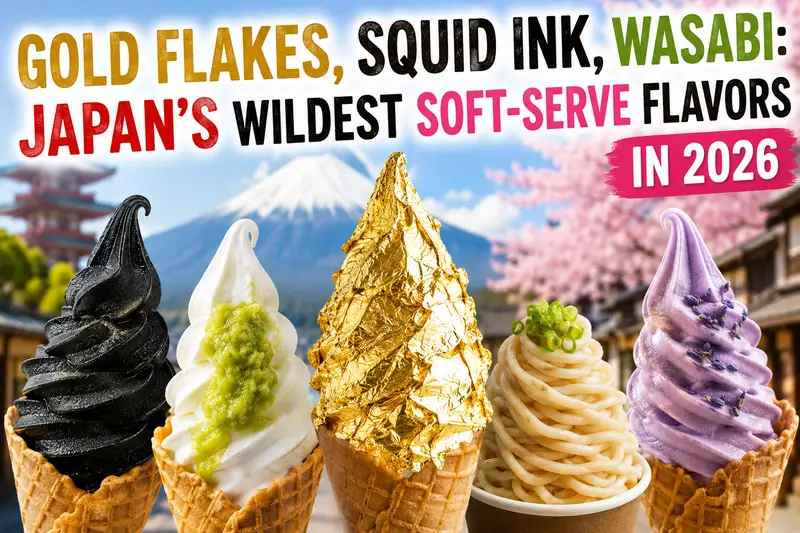
Somewhere in Kanazawa, someone is eating a soft-serve cone covered in real, edible gold leaf. In Hokkaido, someone else is eating one that’s jet black.
Neither of them is doing it as a stunt. This is just what soft serve looks like in Japan right now.
⭐ Bottom Line
Japan treats soft serve as a local specialty, not a generic dessert — nearly every region has its own signature flavor, and most cost $2.25–$6.25 from a walk-up window. The wildest versions (gold leaf, squid ink, custom liqueur blends) are genuinely worth planning a stop for, not just a novelty photo.
- Best for: food-curious travelers who want a cheap, photogenic stop between sightseeing spots
- Budget: $2.25–$3.50 for most regional flavors; up to $6.25 for gold leaf or custom liqueur versions
- Book ahead: not needed — these are walk-up windows, though some sell out on hot summer days
July 3 is officially Soft Serve Day in Japan, marking the date in 1951 when a US military carnival at Meiji Jingu Gaien in Tokyo is widely credited with serving the country’s first cone-style soft serve to the public. Since then, the format has become a local-specialty canvas: across Japan, local farms, roadside stations, and specialty shops have turned regional ingredients into their own distinctive soft-serve flavors, rather than sticking to one national lineup.
That’s the real story behind the wild flavors travelers keep finding on social media — squid ink in Hokkaido, wasabi in Nagano, literal gold flakes in Kanazawa. These aren’t gimmicks invented for tourists. They’re regional pride, served in a cone, and they happen to photograph extremely well.
Part of why the format lends itself to this kind of regional experimentation is structural: a soft-serve base is simple to swap out for a new local ingredient, which makes it an easy way for a small shop, farm stand, or roadside station to turn a regional specialty into something sellable to a walking crowd. That’s why the wildest versions tend to cluster around a place’s actual specialty — wasabi where wasabi is farmed, squid ink where squid is the local catch, gold leaf where gold leaf is produced — rather than being random flavor experiments.
The direct answer for anyone planning around this: yes, it’s worth seeking these out specifically, and no, you don’t need to detour far off a normal itinerary to find several of them — most sit inside cities and towns already on a typical Japan route.
Squid Ink (Ikasumi) — Hakodate, Hokkaido
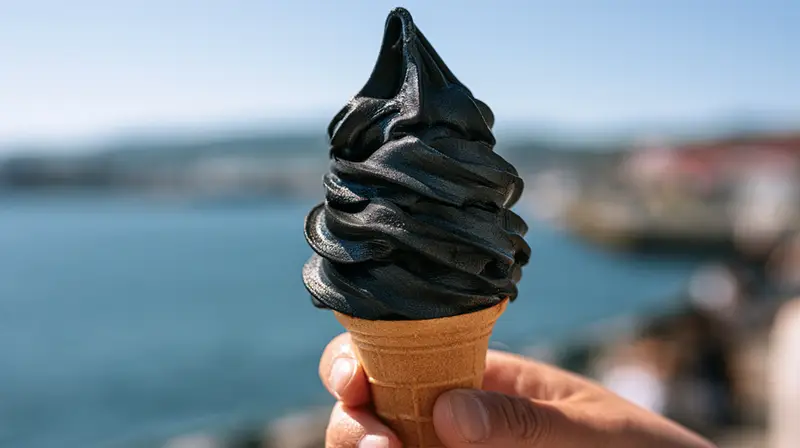
What it looks like: jet black, striking against a pale cone. What it tastes like: subtly sweet with a mild savory note — not fishy, despite the color.
Price: ¥350–¥500 ($2.25–$3.25). Where: Hakodate waterfront shops; select Tokyo specialty shops in Shinjuku. When: year-round, no line typically.
Wasabi — Izu City (Shizuoka) & Azumino (Nagano)
What it looks like: classic white soft serve topped with a spoonful of freshly grated wasabi root. What it tastes like: sweet cream with a gentle, building heat — closer to peppery warmth than sinus-clearing sushi-counter wasabi.
Price: ¥400–¥500 ($2.50–$3.25). Where: Daio Wasabi Farm in Azumino, Nagano, and roadside stations (michi-no-eki) near Izu’s wasabi fields. When: freshest at farms during the harvest season, but sold year-round.
Gold Leaf — Kanazawa, Ishikawa
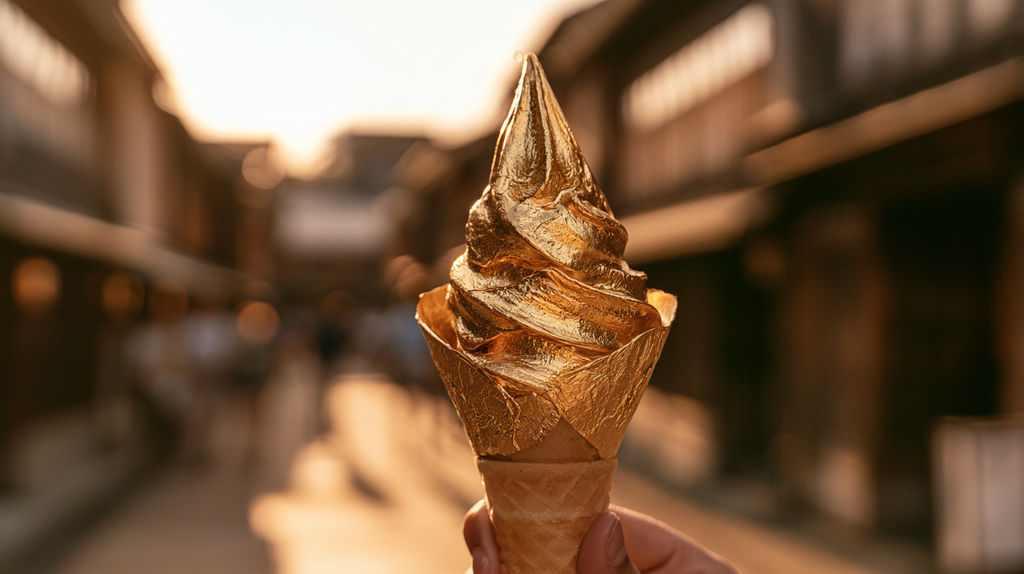
What it looks like: a plain soft serve cone wrapped in a full sheet of edible gold leaf, so thin it clings like foil. What it tastes like: the gold itself is flavorless — this is entirely a visual and novelty experience layered onto a normal vanilla cone.
Price: ¥800–¥1,000 ($5–$6.25). Where: Higashi Chaya district, Kanazawa’s historic geisha quarter, where several shops specialize in it. When: late afternoon light in Higashi Chaya makes for the best photos, and shops can have a short queue on weekends.
Udon-Shaped Soy Sauce Soft Serve — Kagawa Prefecture
What it looks like: extruded through a wide nozzle so it comes out looking exactly like a coiled bowl of noodles. What it tastes like: soy sauce and scallion — savory, not sweet, and genuinely unlike anything else on this list.
Price: ¥400–¥500 ($2.50–$3.25). Where: a handful of specialty shops in Kagawa, Japan’s self-declared udon capital. When: a novelty item, not always in stock at smaller shops — worth calling ahead if it’s the specific reason for the stop.
Build-Your-Own Liqueur Soft Serve — Hiroo, Tokyo
What it looks like: a standard-looking cone with an extra step — you pick a liqueur from a wall of more than 100 bottles to have mixed in. What it tastes like: whatever you choose, since the shop custom-blends each order.
Price: ¥500–¥680 ($3.25–$4.25). Where: Melting In The Mouth Tokyo, a five-minute walk from Hiroo Station. When: confirm with staff which blends contain alcohol if you’re traveling with anyone under Japan’s drinking age of 20 — a non-alcoholic base is typically available for the group.
Lavender — Furano, Hokkaido
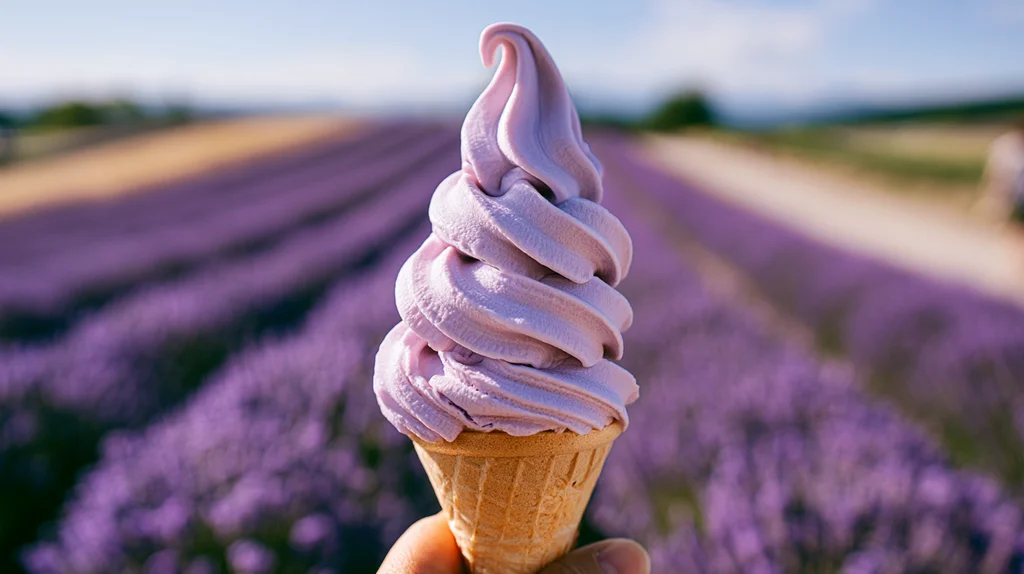
What it looks like: a pale purple swirl, made with real lavender rather than relying on food coloring alone for its color. What it tastes like: floral and gently sweet, with none of the soapy bitterness lavender-flavored food can sometimes have.
Price: ¥400–¥450 ($2.50–$2.75). Where: Farm Tomita in Furano, set against the same lavender fields the region is famous for. When: best from mid-July through early August, when the fields are in full bloom — outside that window, the fields themselves are far less photogenic, even though the soft serve is sold year-round.
Miso — Nagano and the Shinshu Region
What it looks like: a warm beige color, closer to caramel than any other flavor on this list. What it tastes like: salty-sweet, often compared to salted butterscotch — approachable even for travelers who think they don’t like savory desserts.
Price: ¥350–¥450 ($2.25–$2.75). Where: Nagano prefecture’s Shinshu region, known nationally for its miso production. When: sold year-round at farm stands and specialty shops throughout the region.
Skip These If You’re Not Curious: Two Honest Calls
Not every regional flavor is worth a special trip. Bitter melon (goya) soft serve, an Okinawan specialty, delivers exactly the bitterness the vegetable is known for — genuinely polarizing, and a fair number of visitors don’t finish it. Curry-flavored versions, found occasionally near curry-focused restaurants, tend to read as a stunt more than a considered flavor, with mixed reviews even from adventurous eaters. Both are worth trying if the ingredient itself already sounds appealing to you — neither is a flavor most people regret skipping.
Picture the version most people actually remember afterward: standing in Higashi Chaya’s lantern-lit lanes at golden hour, a sheet of gold leaf catching the light on a cone that’s already starting to melt down your hand.
It’s a two-minute photo and a five-minute treat — the memory tends to outlast both.
| Flavor | Where | Price | Best For |
|---|---|---|---|
| Squid Ink | Hakodate, Hokkaido | ¥350–¥500 ($2.25–$3.25) | Adventurous eaters who want the boldest visual |
| Wasabi | Azumino, Nagano / Izu, Shizuoka | ¥400–¥500 ($2.50–$3.25) | Travelers who like a genuine flavor twist, not just color |
| Gold Leaf | Higashi Chaya, Kanazawa | ¥800–¥1,000 ($5–$6.25) | The single best photo on this list |
| Udon-Shaped Soy Sauce | Kagawa Prefecture | ¥400–¥500 ($2.50–$3.25) | Novelty-seekers who want something nobody back home has seen |
| Build-Your-Own Liqueur | Hiroo, Tokyo | ¥500–¥680 ($3.25–$4.25) | Adults wanting a customizable, grown-up treat |
| Lavender | Furano, Hokkaido | ¥400–¥450 ($2.50–$2.75) | Summer visitors already seeing the lavender fields |
| Miso | Shinshu region, Nagano | ¥350–¥450 ($2.25–$2.75) | Travelers who like a caramel-like flavor with a twist |
✅ Go if you are:
- the kind of traveler who plans small food stops around a trip’s bigger sightseeing days
- curious about how far a simple format like soft serve can be pushed regionally
- looking for a cheap, fast souvenir-worthy photo between train connections
- comfortable trying something that sounds odd on paper (squid ink, wasabi) for a genuinely good flavor payoff
❌ Skip if you are:
- strictly a classic-vanilla-only eater with no interest in savory or bitter flavor twists
- not going anywhere near Hokkaido, Nagano, or Kanazawa and don’t want to seek out Tokyo substitutes
- traveling in winter to a region where a specific flavor is a seasonal, farm-only item
- Is squid ink soft serve actually fishy?
- Not really — most people describe it as subtly savory with a clean, sweet finish. The color is far more dramatic than the flavor.
- Can I find any of these flavors in convenience stores?
- No, these are specialty shop and farm-stand items, not mass-market convenience store products, though convenience stores do carry their own rotating seasonal soft-serve flavors separately.
- Is the gold leaf on the Kanazawa cone safe to eat?
- Yes — it’s food-grade edible gold leaf, the same kind used on Japanese confectionery and sake, and Kanazawa produces the vast majority of Japan’s gold leaf.
- Do these shops take credit cards?
- Many smaller walk-up stands and farm-stand locations are cash-preferred or cash-only; carry a few thousand yen in small bills and coins to avoid a wasted stop.
- What’s the best season to try these?
- Summer, both because soft serve is at its most appealing in the heat and because farm-based flavors like wasabi and lavender are freshest during their local harvest or bloom season.
- Are portions large enough to share?
- Most cones are a single-person portion, but the flavor payoff is strong enough that splitting one to sample it is common, especially for the pricier gold leaf version.
- Why does almost every region have its own flavor instead of one national favorite?
- Soft-serve machines are inexpensive to run and simple to restock with a new base, which makes the format an easy way for a small farm stand or shop to turn a single local ingredient — wasabi, gold leaf, squid ink — into a sellable, walkable snack, rather than something that requires a full kitchen.