
Break an etiquette rule in Japan and almost nothing happens. No fine. No lecture. No raised voice.
That’s exactly the problem — you usually won’t find out until it’s already too late. These are the seven mistakes that catch visitors most often.
⭐ Bottom Line
Japan runs on dozens of unwritten social rules that nobody will ever explain to you out loud — these are the 7 that trip up first-time visitors most often, plus the one principle that quietly explains all of them.
- Best for: first-time visitors, especially from countries without a strong queuing or quiet-in-public culture
- Budget: $0 — none of this costs money, except the two fines noted below
- Book ahead: nothing to book; just read this before you land
Japan doesn’t enforce most etiquette with fines or lectures. It enforces it with something harder to spot: a quiet, collective expectation that you won’t make life harder for the people around you. Break one of these unwritten rules and the usual response isn’t a raised voice — it’s a beat of silence, then everyone quietly working around you. Most visitors never even notice it happened.
So which rules actually matter, and which are exaggerated for clicks? A handful genuinely register with locals, and Japanese people are remarkably forgiving of visitors who get the rest wrong. The seven below are the ones that come up most often — plus the single idea, meiwaku, that quietly explains all of them once you see it.
1. The Toilet Slippers You Can Accidentally Wear Back to the Table
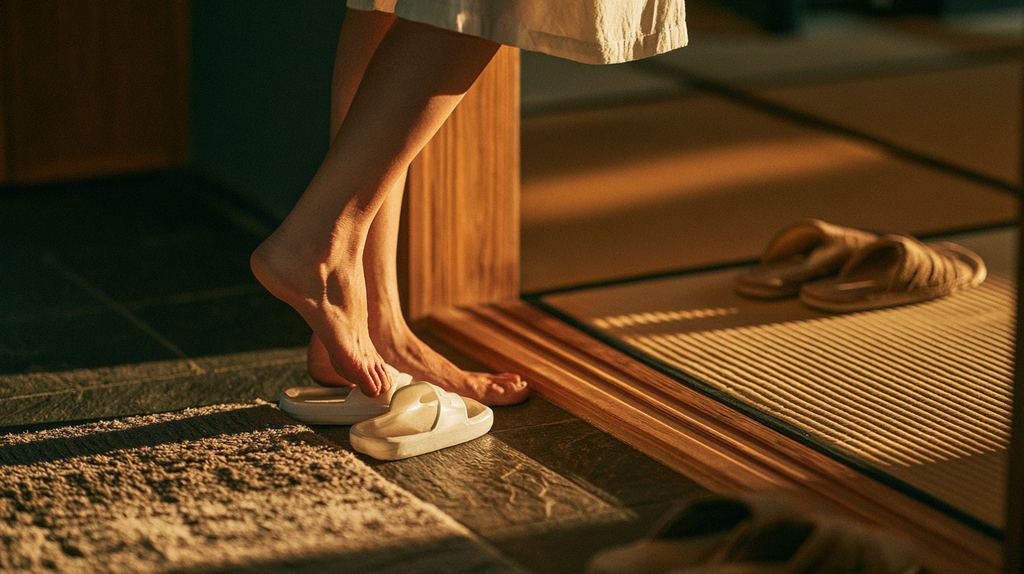
You step out of the restroom. Nobody says anything. You sit back down. It isn’t until a few minutes later, glancing down, that you notice: you’re still wearing the small plastic slippers meant only for the bathroom floor.
Traditional restaurants, ryokan, and even some temples keep a separate pair of slippers just inside the bathroom door, because that floor is treated as its own space. You switch into them at the threshold, use the toilet, and switch back into your regular indoor slippers — or bare feet on tatami — on the way out. Etiquette guides consistently flag the forgotten switch-back as the single most common slip-up first-timers make.

Most guides stop here. But this one has a regional twist that catches even careful travelers off guard.
2. The Escalator Rule That Flips When You Change Cities
Quick test: you’re on an escalator in Tokyo. Which side do you stand on?
Left. Now you land in Osaka, 2.5 hours away by Shinkansen. Everything flips — stand on the right instead. The confusing part isn’t just that the two cities disagree; it’s that neither side is technically the official rule anymore. From July 21 to August 31, 2026, a coalition of 58 railway operators ran a nationwide campaign asking riders to simply stand still and hold the handrail, and Saitama prefecture has gone further, passing an ordinance that makes standing still the legal expectation. A 2024 Japan Elevator Association survey found over 90% of respondents now agree that walking on escalators should stop entirely.
If you forget which city you’re in, there’s a simpler fix than memorizing a map: just match whoever stepped onto the escalator ahead of you, and stand still either way.
3. Slurping Isn’t the Sin You Think It Is
❌ “You can’t eat or make noise while eating in Japan.” Not true — not even close.
Japan’s tourism board actively encourages slurping noodles as proper ramen and soba etiquette; audibly enjoying your bowl reads as a compliment to the kitchen, not bad manners. The rule tourists actually get backwards is about walking, not slurping. It isn’t “never eat outside” — it’s closer to “don’t turn yourself into a moving obstacle with dripping food and nowhere to put the trash,” largely because Japan has very few public trash cans.
At a festival, eating while wandering the stalls is completely normal. On a long-distance Shinkansen, an ekiben boxed lunch is expected, not frowned upon. Squeezing through a packed shopping street with something messy in hand is where the looks actually begin.

Two rules down, five to go — and the next one comes with an actual price tag.
4. The Photo in Kyoto That Can Cost You ¥10,000
¥10,000. One photo. That’s the on-the-spot fine Kyoto has enforced since 2019 for photographing geisha or maiko inside Gion’s private alleys.
Don’t try to guess which alleys count as private — look for the signage instead. Restricted streets are marked with a red circle over a crossed-out camera icon; the main public thoroughfare, Hanamikoji, and other public roads remain unrestricted. If you don’t see a sign, you’re likely fine, but when in doubt, stay on the main street and photograph from a respectful distance.
This is one of only two rules on this list with real money attached. Here’s the other.
5. The ¥2,000 Mistake You Can Make Before You Even Finish a Cigarette
You step out of the station, light a cigarette, and start walking toward your next stop. In parts of central Tokyo — Chiyoda and Shibuya among them — that alone can cost you about ¥2,000, issued on the spot by ward patrol staff. It isn’t a national law, which is exactly why so few visitors know it exists until they’re standing in front of an officer.
Designated smoking areas — often small glass-walled booths on street corners — are the workaround, and they’re more common near stations and business districts than most travelers expect.

The last two rules on this list aren’t about money at all.
6. Your Phone Rings on a Packed Train. Now What?
It happens to almost every visitor eventually: your phone rings in a silent train car, and every head within ten feet turns slightly toward you. You have about one second to decide what to do next.
The answer: silence it immediately, and if the call is genuinely urgent, keep it as short as possible and take it after you’ve gotten off. Phone calls on Japanese trains aren’t just discouraged, they’re close to unthinkable — Japan’s tourism board flags keeping phones on silent, locally called “manner mode,” as one of the most consistent rules of public transit etiquette. Quiet conversation between friends is generally fine; a phone held to your ear is not.
The reasoning traces back to a single idea that shows up everywhere in Japanese public life: meiwaku, not causing trouble for the people around you. It’s the same idea behind priority seating near train doors, set aside for elderly, pregnant, or disabled riders — offering yours up when someone needs it is simply expected.
7. The Photo Mistake That Isn’t Always Illegal — But Still Makes People Uncomfortable
A shopkeeper. A stranger in a beautiful kimono. A group of schoolkids on a field trip. A cozy restaurant interior with three other tables in frame. All four are things tourists photograph constantly in Japan without a second thought — and all four sit in a genuine gray zone.
Japan recognizes a legal concept called shozoken, or portrait rights: broadly, the idea that people control how their own image gets used. Taking a candid photo of a stranger in public isn’t automatically illegal — Japan’s constitution protects freedom of expression — but publishing or sharing an identifiable photo without asking can cross into a genuine privacy complaint, and simply pointing a camera at someone uninvited is enough to make many people visibly uncomfortable. Photos of children, especially school groups, are an even more sensitive version of the same rule.
Kyoto’s Gion fine from earlier is the legally enforced extreme version of this same courtesy. Everywhere else in Japan, the same instinct applies without a fine attached — which is exactly why it’s so easy to miss.
The One Rule Behind All Seven
Look back at everything above and one idea threads through all of it: meiwaku, the effort to avoid causing trouble for the people around you. It’s why the toilet slippers stay separate, why the escalator habit persists even without an official rule behind it, why a ringing phone draws glances, and why pointing a camera at a stranger feels different in Japan than it might at home.
It also explains the enforcement mechanism itself: there mostly isn’t one. Break most of these rules and nobody will shout, correct you, or ask you to leave. What you’ll get instead is a beat of silence or a quick glance — locals working around you rather than confronting you directly.
Picture the moment it clicks: you step off a packed escalator without a second thought, phone already silenced, slippers switched back before you even notice you did it — moving through Tokyo the way someone who’s done this before would.
You’ll still get something wrong at some point. Almost everyone does, and almost nobody notices.
What This Means for Your Trip
None of these seven rules require research once you’re actually in Japan — they’re the kind of thing you absorb by watching the people around you for about ten minutes. The one habit worth bringing with you: when in doubt, do what the local next to you is doing.
The only two rules with real financial consequences — the Gion photography fine and the walking-while-smoking fine — are also the easiest to avoid entirely, since both come with clear physical signage once you know to look for it.
At a Glance: All 7 Rules
| Rule | Where It Applies | What Happens If You Miss It | The Fix |
|---|---|---|---|
| Toilet slippers | Restaurants, ryokan, temples with tatami | Awkward stares, nothing more | Switch back before leaving the bathroom |
| Escalator side | Tokyo (left) vs. Osaka/Kansai (right) | You block foot traffic | Copy the person ahead of you; stand still |
| Eating while walking | Streets outside festivals | Seen as inconsiderate, not illegal | Finish messy food near the stall first |
| Photos in Gion’s private alleys | Kyoto’s Gion district | ¥10,000 (~$90) fine | Shoot from Hanamikoji or other public roads |
| Smoking while walking | Chiyoda, Shibuya, other central wards | ¥2,000 on-the-spot fine | Use designated glass-booth smoking areas |
| Phone calls on trains | All train and subway lines | Disapproving looks, not a fine | Silence your phone before boarding |
| Photographing strangers without asking | Anywhere in public, especially with kids or in Gion | Discomfort, or a privacy complaint if shared online | Ask first: “sumimasen, shashin ii desu ka?” |
Frequently Asked Questions
- Do I need to speak Japanese to avoid these mistakes?
- No. None of the seven rules above require language — they’re behavioral, not verbal. Watching what people around you do covers almost every situation.
- Will I actually get in trouble for breaking these rules?
- For five of the seven, no — the “penalty” is social disapproval, not a fine or confrontation. Only the Gion photography rule and the walking-while-smoking rule carry an actual, enforced fine.
- Is it true you can’t eat or drink anything on the street in Japan?
- No, that’s an exaggeration. Eating near a food stall right after buying something is completely normal, and festival areas are even more relaxed. The etiquette issue is walking with messy food through a crowd, not eating in public generally.
- Are these rules the same in Tokyo and Osaka?
- Mostly, with the escalator rule as the clearest exception — Tokyo and Osaka genuinely disagree on which side to stand, and Kyoto can vary by station or line. Current safety campaigns are pushing both cities toward the same “just stand still” message regardless.
- What if I make a mistake without realizing it?
- Usually, nothing dramatic happens. Japan isn’t a country where strangers routinely confront tourists over small etiquette missteps. If you notice people around you reacting, pause, look around, and adjust — showing effort matters more than getting everything perfect.
- What’s the single etiquette rule that matters most?
- Keeping your phone on silent and off your ear on trains and buses. It’s the rule locals mention most consistently as the one that actually affects the people around you.