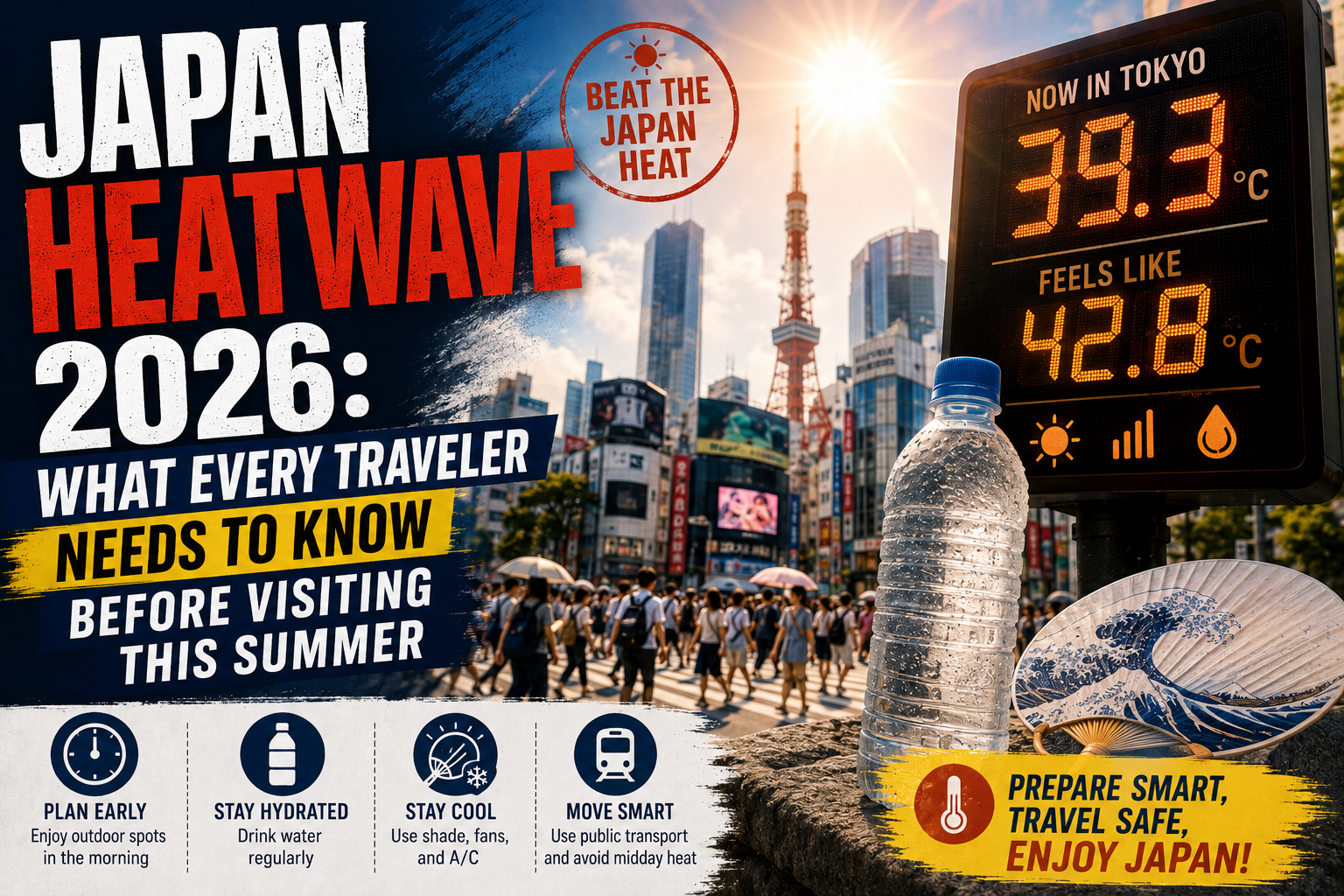
If you’re planning a trip to Japan this summer, you’ve probably already seen the headlines. In mid-July 2026, several areas of Kyushu recorded temperatures as high as 39.3°C, tying the region’s all-time record and triggering fresh travel advisories across southwest Japan. The heat isn’t a one-day fluke, either — Japan’s Meteorological Agency has forecast an above-normal summer nationwide, with the Pacific High expected to strengthen once the rainy season fully clears.
None of this means you should cancel your trip. It does mean you should plan differently than you would for a spring or autumn visit. This guide breaks down what’s actually happening, which regions are hit hardest, what it will cost you to stay comfortable, and how to build a summer itinerary that works with the heat instead of against it.
What’s Actually Happening This Summer

The current heatwave is concentrated in southwest Japan, with Kyushu bearing the brunt of it so far. Local authorities have urged both residents and visitors to adjust outdoor plans and monitor conditions closely, particularly during early afternoon hours. According to JMA’s seasonal outlook, summer 2026 (June through August) is expected to run above normal nationwide, meaning this isn’t an isolated spike — it’s the shape of the whole season.
The practical takeaway for travelers: Japan remains open, welcoming, and absolutely worth visiting in summer. You just need a plan that accounts for real, sometimes dangerous heat rather than the postcard version of a Japanese summer.
This isn’t a hypothetical forecast — it’s already happening. The record-tying reading in Kyushu was recorded in mid-July 2026, and local authorities responded almost immediately with public advisories encouraging both residents and visitors to rethink outdoor schedules. If you’re booking a trip for the next few weeks, treat that as the baseline condition you’re planning around, not a worst-case scenario. It’s also worth checking the Japan Sport Council’s daily heat-risk index before heading out each morning, since the risk level can shift noticeably from one day to the next even within the same week.
Region-by-Region Heat Guide
Not all of Japan bakes equally. Here’s how the major travel regions compare this summer, and what that means for your itinerary.
| Region | Typical Daytime Heat | Traveler Takeaway |
|---|---|---|
| Kyushu (Fukuoka, Kagoshima) | Very high — record readings near 39°C | Front-load sightseeing before 10am; treat midday as indoor time |
| Kansai (Osaka, Kyoto, Nara) | High, with intense humidity | Combine temple visits with air-conditioned museums and department stores |
| Kanto (Tokyo, Yokohama) | High, slightly less extreme than Kansai | Use the subway and shopping arcades as cooling corridors between stops |
| Japanese Alps (Kamikochi, Takayama) | Moderate — noticeably cooler at elevation | A strong alternative base if you want mountain air over city heat |
| Hokkaido | Mild — rarely breaks 30°C | The most comfortable region in Japan for a July or August visit |
Practical Tips for Beating the Heat
Here’s what actually works on the ground, based on how locals handle it every year:
- Drink water constantly. Aim for roughly 500ml per hour when you’re outdoors, even if you don’t feel thirsty.
- Front-load your sightseeing. Visit shrines, gardens, and outdoor markets between 7am and 10am, before the heat peaks.
- Use convenience stores as cooling stations. Every konbini has air conditioning, cold drinks, and a place to catch your breath — use them liberally.
- Carry a handheld fan or cooling towel. These are sold everywhere in summer and genuinely help.
- Pro tip: department store basements (depachika) are air-conditioned, free to enter, and double as an excellent food-hunting detour during the hottest hours.
- Watch for warning signs of heat exhaustion in yourself and travel companions — dizziness, heavy sweating that suddenly stops, or confusion mean it’s time to get indoors immediately.
What It Costs to Stay Cool

Staying comfortable in a Japanese summer doesn’t have to blow your budget, but it’s worth planning for a few extra line items:
- Cooling towels and portable fans: roughly ¥500–¥1,500 ($3–$10) each, sold at any drugstore or convenience store
- Bottled water and sports drinks: ¥120–¥250 per bottle; budget an extra ¥1,000–¥1,500 ($7–$10) per day if you’re out sightseeing most of the day
- Indoor attractions as heat breaks: museum and aquarium tickets typically run ¥1,000–¥2,500 ($7–$17), and doubling up as air-conditioned refuges makes the cost easier to justify
- Taxis over walking during peak heat: a short ¥1,000–¥2,000 ($7–$14) ride can save you from a genuinely risky midday walk
None of this needs to strain a typical travel budget — it’s more about redirecting a small amount of spending toward comfort and safety rather than cutting corners on it.
Access and Getting Around in the Heat
How you move matters as much as where you go. In Tokyo and Osaka, the subway network itself is air-conditioned and often the fastest way to hop between neighborhoods without long outdoor walks. From Tokyo Station or Shinjuku Station, most major sightseeing areas are 15–30 minutes by train, which makes it easy to structure a day around short outdoor bursts connected by cool transit. If you’re heading from Tokyo toward Kyoto or Kyushu, the Shinkansen is fully air-conditioned end to end, so long-distance travel days can actually double as recovery time from the heat.
Cooler Alternatives If You Want to Skip the Worst of It

If your travel dates are flexible, shifting part of your itinerary north or up in elevation can change the entire feel of your trip. Hokkaido in particular runs 5–10 degrees cooler than Tokyo or Osaka through most of summer, and cities like Sapporo and Hakodate are built around outdoor markets, seafood, and lake views that are genuinely pleasant to explore at midday rather than something to endure. The Japanese Alps — Kamikochi, Takayama, Matsumoto — offer a similar escape closer to the Tokyo-Kyoto corridor, with mountain trails, cold rivers, and traditional towns that feel a world away from the concrete heat of the big cities.
A common strategy this time of year is to front-load your trip with 2–3 days in a cooler region before or after the classic Tokyo-Kyoto-Osaka route, using it as a natural reset rather than treating the whole trip as one long heat marathon. It also spreads out your risk: if a particular week turns out unusually brutal in the cities, you’ll already have built in a few days where that simply isn’t a factor. This is also a good way to justify the extra cost and travel time — the price of a domestic flight or long-distance train to Hokkaido is easy to offset against a couple of nights you would have spent hiding from the heat in Tokyo anyway.
Packing List for a Japanese Summer
What you bring matters almost as much as how you schedule your days. A few essentials consistently make the difference between a miserable afternoon and a manageable one:
- Lightweight, breathable clothing in pale colors — linen and quick-dry synthetics both work well
- A wide-brim hat or UV umbrella (widely used by locals, not just tourists)
- High-SPF sunscreen, ideally one rated for humidity so it doesn’t wash off with sweat
- A refillable water bottle — many stations and convenience stores now have water refill points
- Electrolyte tablets or sports drink powder, useful for longer days outdoors, generally under ¥500 ($3) for a travel pack
Our Verdict — Is Summer Still Worth It?
Yes — with a caveat. Summer in Japan means real festivals (Gion Matsuri, Sumida River fireworks, Tenjin Matsuri), fewer international tourists in the biggest cities, and a version of Japanese culture built entirely around surviving and even celebrating the heat. But this year’s conditions mean you should treat the season with real respect rather than pushing through it.
Best for: travelers who can build a flexible, heat-aware itinerary — mornings outdoors, afternoons indoors, and a willingness to swap a packed schedule for a slower one.
Bottom line: if your dates are flexible and extreme heat sounds miserable rather than manageable, consider Hokkaido or the Japanese Alps instead of Honshu’s big cities. If you’re set on Kyoto or Tokyo, plan around the heat rather than hoping it won’t be that bad.
Frequently Asked Questions
- Is it safe to visit Japan during the 2026 heatwave?
- Yes, Japan remains a safe and welcoming destination. The key is adjusting your daily schedule — prioritizing early mornings and evenings for outdoor activities and using air-conditioned spaces during peak afternoon heat.
- What is the hottest region in Japan right now?
- Kyushu has recorded the most extreme temperatures this summer, including a reading of 39.3°C that tied a regional all-time record in mid-July 2026.
- Which part of Japan is coolest in summer?
- Hokkaido offers by far the mildest summer climate in Japan, rarely reaching 30°C, followed by higher-elevation areas like the Japanese Alps around Kamikochi and Takayama.
- What’s the best time of day to sightsee in summer?
- Early morning, roughly 7am to 10am, before the heat peaks. Many travelers also shift outdoor activities to early evening once temperatures start dropping.
- Do I need to change my itinerary because of the heat?
- Not entirely, but it helps to alternate outdoor sightseeing with indoor stops like museums, department stores, and aquariums, and to build in more transit time using air-conditioned trains and subways.