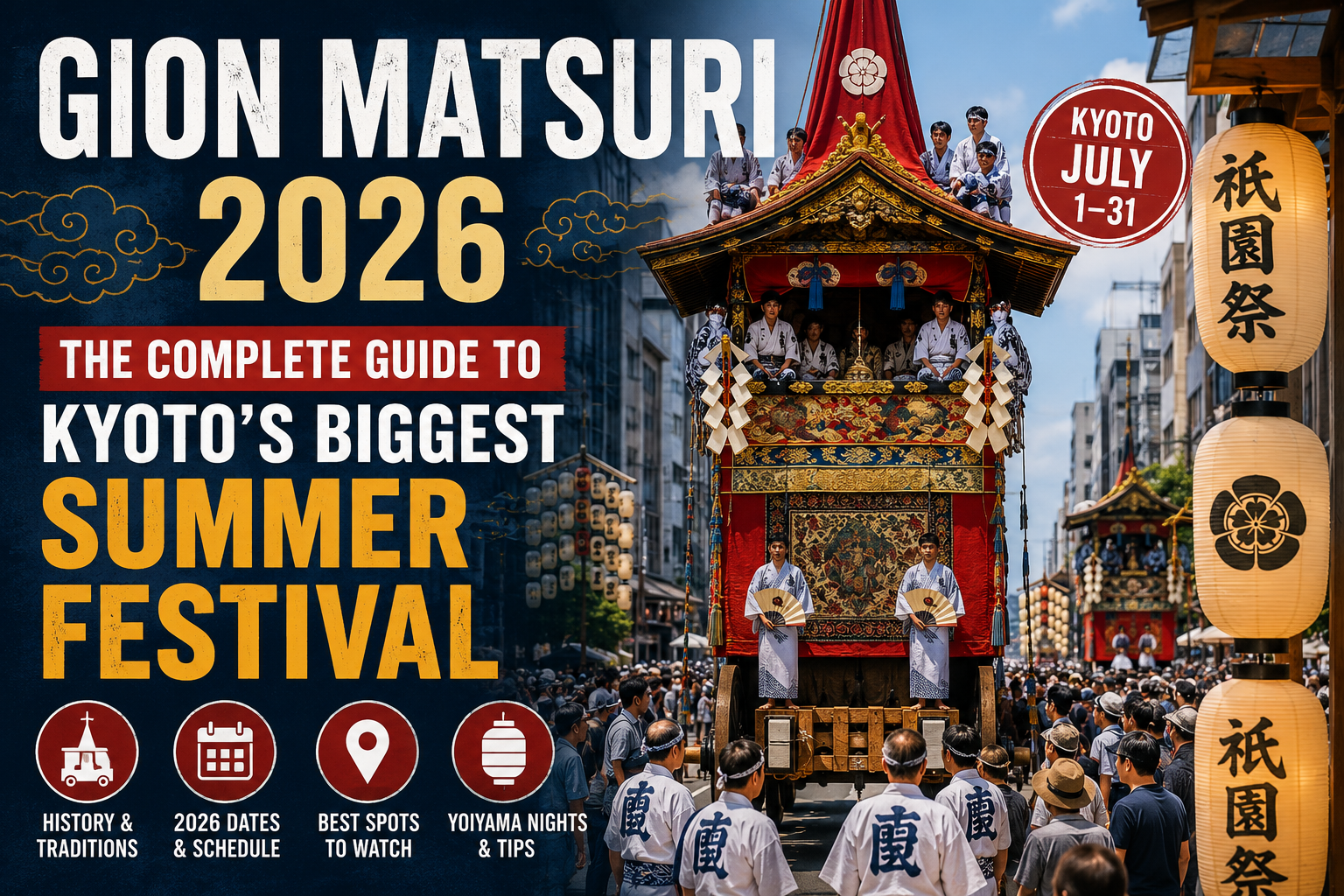
If there’s one festival that captures everything people love about a Japanese summer, it’s Kyoto’s Gion Matsuri. Unlike most festivals that wrap up in a day or two, Gion Matsuri runs the entire month of July, building toward two grand processions of towering wooden floats through the streets of downtown Kyoto. If you’re planning a July trip to Japan, this is the single event worth building your itinerary around.
What Is Gion Matsuri, Exactly?

Gion Matsuri is the annual festival of Yasaka Shrine, with roots going back over 1,100 years to a purification ritual meant to ward off plague and disaster. Today it’s considered one of Japan’s three great festivals, and the centerpiece is the yamaboko junko — a procession of enormous, elaborately decorated wooden floats, some over 25 meters tall, hand-pulled through central Kyoto by teams of dozens of people. Many of the floats are adorned with imported tapestries dating back centuries, which is why the event is sometimes nicknamed a “moving museum.”
The festival traces back to 869 AD, when a plague swept through Kyoto and the imperial court staged a purification ritual known as the goryo-e, parading 66 ceremonial spears through the city to ward off the disease. What began as a religious response to crisis gradually evolved over centuries into the elaborate procession of decorated floats seen today, with individual neighborhoods taking responsibility for building, maintaining, and pulling their own float — a tradition that continues largely unchanged into the present.
The Two Main Parades — Don’t Miss These Dates
While the festival runs all month, almost everything travelers care about clusters around two key processions:
| Event | Date | Details |
|---|---|---|
| Saki Matsuri (first parade) | July 17 | The larger, more famous procession — 23 floats, runs roughly 9:00am–1:00pm |
| Ato Matsuri (second parade) | July 24 | A smaller, quieter procession with around 11 floats, less crowded and easier to view up close |
| Yoiyama evenings | July 14–16 & 21–23 | Pre-parade evenings when floats are illuminated with lanterns and streets fill with food stalls |
Pro tip: if you can only attend one part of the festival, choose a Yoiyama evening over the parade itself. The atmosphere — lantern-lit floats, festival food, yukata-clad crowds — is arguably more memorable than the daytime procession, and it’s far less physically demanding to attend.
What Happens the Rest of the Month

The parades and Yoiyama evenings get most of the attention, but Gion Matsuri technically opens on July 1 with a series of quieter shrine rituals and closes on July 31 with the Nagoshisai purification ceremony. Between the two main processions, neighborhood float committees hold public viewings where you can walk right up to the floats mid-construction, and evening yoiyama-style gatherings happen on a smaller scale throughout the month in different districts. Committee members typically welcome respectful onlookers during these public viewings, though flash photography and touching the floats are discouraged out of respect for centuries-old craftsmanship. If your travel dates don’t line up with July 17 or 24, it’s still worth checking the festival calendar — there’s almost always something happening somewhere in the city.
It’s also worth noting how this compares to some of Japan’s other headline summer festivals. Tokyo’s Sumida River fireworks and Osaka’s Tenjin Matsuri are both single-day or single-evening events — spectacular, but over quickly. Gion Matsuri’s month-long structure means a delayed flight, a rescheduled hotel, or a change of plans rarely costs you the whole experience the way it would with a one-night festival elsewhere in the country. That flexibility alone makes it one of the more forgiving major events to build a first-time Japan itinerary around.
Where to Watch and How to Get There
The parade route runs through central Kyoto near Karasuma Oike Station and Shijo Station, both easily reached from Kyoto Station in about 15 minutes by subway or bus. For Yoiyama evenings, the festival concentrates around Shijo-dori and Karasuma-dori, walkable from either station. If you’re coming from Osaka or Tokyo, the Shinkansen into Kyoto Station connects directly to the subway lines serving the festival area, making a day trip entirely feasible even if you’re not staying in Kyoto.
Free viewing is available along most of the parade route if you arrive early, but for a guaranteed seat, paid grandstand tickets are sold in advance through the Kyoto Tourism Association and typically run ¥4,000–¥6,000 (roughly $27–$40) per seat.
Budgeting for Gion Matsuri
Attending the festival itself is largely free, but a few costs are worth planning for:
- Grandstand seating for the parade: ¥4,000–¥6,000 (~$27–$40), sold out weeks in advance for July 17
- Festival food stalls during Yoiyama: budget ¥2,000–¥3,000 (~$13–$20) per person for a full evening of street food
- Yukata rental, if you want to dress for the occasion: ¥3,000–¥6,000 (~$20–$40) including dressing service
- Kyoto hotel rates during mid-to-late July: expect a premium of 20–40% over off-season rates due to Yoiyama-week demand
Compared to a lot of Japan’s ticketed seasonal events, Gion Matsuri remains remarkably accessible — there’s no admission fee to walk the Yoiyama streets or view the parade from open sections of the route, which makes it an easy addition to a Kyoto trip even on a tight budget. The main costs come from optional upgrades: better seating, festival food, and the premium Kyoto hotels charge during the festival’s peak dates.
Booking Kyoto Hotels for the Festival
This is the detail that catches the most travelers off guard: Yoiyama week sells out 6–12 months in advance at popular hotels near the festival area. If you want to stay walking distance from Shijo or Karasuma, book as early as you can once your dates are set — waiting until a month or two out often means settling for accommodations well outside central Kyoto, which adds a meaningful commute during the festival’s busiest evenings.
Common Mistakes to Avoid
- Assuming one visit covers the whole festival. Gion Matsuri runs the entire month; showing up outside mid-to-late July means missing both the floats and the Yoiyama atmosphere entirely.
- Trying to see both parades in one trip without planning around the gap. July 17 and July 24 are a full week apart, so build your itinerary around one or the other rather than assuming you can catch both on a short visit.
- Skipping the heat precautions. The parade runs through some of the hottest hours of a Kyoto July day; bring water, a hat, and a cooling towel regardless of how short you expect to stay.
- Overpacking the day. Festival crowds and heat compress your stamina faster than a normal sightseeing day — plan two or three activities maximum around the parade, not a full Kyoto itinerary on top of it.
- Not checking the weather forecast day-of. Gion Matsuri falls right in the heart of Kyoto’s hottest, most humid stretch of summer, and conditions can shift from tolerable to genuinely risky within the same afternoon — build flexibility into your plans rather than committing to a fixed schedule regardless of conditions.
Our Verdict — Is Gion Matsuri Worth Building a Trip Around?
Yes, without much hesitation. Few festivals in Japan combine this much visual spectacle, historical depth, and genuine local participation in one event. Best for: travelers who want an authentic, high-energy cultural experience rather than a curated tourist show — this is a festival Kyoto residents actually attend and care about, not a performance staged for visitors. Bottom line: if your July travel dates have any flexibility, shift them to land on July 14–17 or July 21–24, and book your Kyoto hotel the moment your dates are confirmed.
Frequently Asked Questions
- When exactly is Gion Matsuri in 2026?
- The festival runs throughout July, with the two main float processions on July 17 (Saki Matsuri) and July 24 (Ato Matsuri), and Yoiyama evening celebrations in the days leading up to each.
- Which is better to attend, the parade or Yoiyama?
- Yoiyama evenings tend to offer a more memorable, atmospheric experience with illuminated floats and food stalls, while the daytime parade offers the spectacle of the floats in motion. Many travelers prioritize Yoiyama if they can only attend one.
- Do I need tickets to watch the parade?
- No, free viewing is available along most of the route if you arrive early. Paid grandstand seats are available for a guaranteed view but sell out well in advance.
- How do I get to the festival from Kyoto Station?
- Karasuma Oike Station and Shijo Station, both near the festival area, are about 15 minutes from Kyoto Station by subway or bus.
- Is Gion Matsuri suitable for families with children?
- Yes, though the heat and crowds during peak Yoiyama evenings can be intense. Consider visiting earlier in the evening before crowds peak, and prioritize shade and hydration throughout. If you’re traveling with kids, the daytime Ato Matsuri parade on July 24 tends to be a gentler introduction than the larger, more crowded Saki Matsuri procession a week earlier.