Okinawa searches from Australia jumped 71% between 2024 and 2025 — Expedia now ranks it the second-hottest destination on Earth for 2026, behind only Big Sky, Montana.
Yet Okinawa was still only Japan’s 12th most-visited prefecture by international travelers in 2024. Something doesn’t add up, and it isn’t a coincidence.
⭐ Bottom Line
Okinawa now offers Kyoto-level global buzz with a fraction of Kyoto’s crowds — plus a countdown clock, since Shuri Castle’s rebuilt main hall reopens November 23, 2026 after a 2019 fire.
- Best for: Australians who’ve already done a mainland Japan trip, or first-timers who want beaches without leaving the country
- Budget: Comparable to a Kyoto/Osaka leg — AUD still buys roughly 100–105 yen, well above historical averages
- Book ahead: Naha hotels for November 2026 — the Shuri Castle reopening window will compress availability fast
More than 1 million Australians visited Japan in 2025, a record 15% jump, and Japan has now overtaken the US as Australia’s third most popular destination overall. Almost every one of those trips still follows the same route: Tokyo, then Kyoto, then Osaka. It’s a great route. It’s also, increasingly, a crowded one.
Australian passport holders get straightforward visa-free entry for short tourism stays, and direct flights from Sydney, Melbourne, and Brisbane to Tokyo run around 9–10 hours — convenient enough that a second or third Japan trip has become normal rather than exceptional for many Australian travelers. That repeat-visitor pattern is exactly why destinations beyond the well-worn Tokyo-Kyoto-Osaka triangle are gaining ground: once you’ve done the classic route, the question becomes what’s genuinely different, not just what’s next on the list.
Meanwhile, 1,600 kilometers southwest — closer to Taipei than to Tokyo — a subtropical island chain most of those travelers have never set foot on is quietly becoming the story mainland Japan can’t tell anymore: white sand, coral reefs, a culture that isn’t mainland Japanese at all, and crowds that haven’t caught up to the hype. Here’s what’s actually driving Australians toward it, and where the two destinations genuinely differ.
Crowds: What Kyoto’s 2026 Numbers Actually Look Like

Kyoto’s overtourism problem isn’t a rumor — it’s the reason the city keeps making global headlines for bus restrictions, geisha photography bans, and record hotel taxes. Fushimi Inari and Kiyomizu-dera now draw crowds dense enough that some of Kyoto’s own hidden gems require a 30-minute walk past tour buses just to find a quiet moss garden.
Kyoto’s local government has responded with hotel tax hikes reaching up to ¥10,000 a night at luxury properties, new restrictions on photography in parts of Gion, and adjusted bus routes aimed specifically at easing pressure on the most-photographed spots. None of that has meaningfully thinned the crowds at Fushimi Inari or Kiyomizu-dera during peak hours — it has mostly raised the price of visiting them.
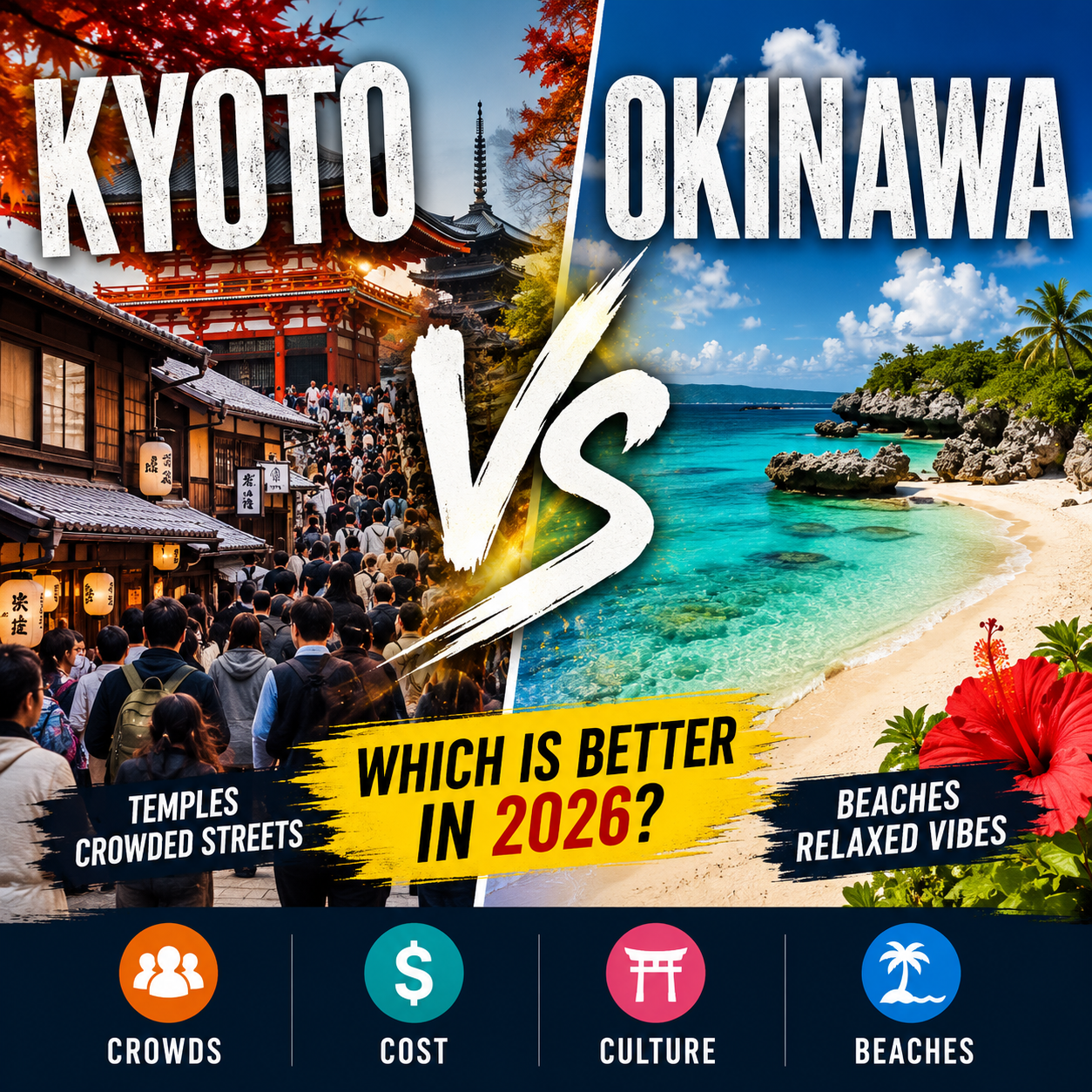
Kyoto vs Okinawa: Where the Real Differences Are
| Factor | Kyoto | Okinawa | Best For |
|---|---|---|---|
| Crowd level (2026) | Extremely high at major sites, worsening | Rising fast but still well below Kyoto | Okinawa, if crowds are your dealbreaker |
| Core experience | Temples, gardens, traditional mainland culture | Beaches, coral reefs, distinct Ryukyu culture | Depends what you want from the trip |
| Rail travel | Full JR/Shinkansen network | No JR network at all — monorail + rental car | Kyoto, for JR Pass holders |
| Climate | Four distinct seasons, best spring/autumn | Subtropical, warm nearly year-round | Okinawa, for winter escapes |
| Access from Australia | Fly into Tokyo/Osaka, then train | Fly into Tokyo/Osaka, then domestic flight to Naha | Roughly equal extra effort either way |
What Okinawa Gives You That Kyoto Can’t

This is the part most first-time visitors don’t expect: Okinawa isn’t simply \”Japan with beaches.\” Until 1879, it was the independent Ryukyu Kingdom, with its own language, textiles, cuisine, and architecture shaped by centuries of trade with China and Southeast Asia. Naha’s Kokusai-dori shopping street, the Karate Kaikan (karate originated here), and dishes like Okinawa soba and bitter-melon champuru all reflect a culture genuinely distinct from Kyoto’s.
Then there’s the coastline. Yonaha Maehama Beach on Miyako Island is regularly ranked among the best beaches in East Asia — the kind of water clarity travelers associate with Thailand or the Philippines, reached without leaving Japan’s transport and safety standards behind.
Picture stepping off a monorail in Naha into warm subtropical air, palm trees lining Kokusai-dori, and forty minutes later standing on sand so pale it looks bleached, facing water in three shades of blue.
It’s a genuinely different Japan — though summer humidity and occasional typhoons are part of that same subtropical trade-off.
The Countdown Nobody’s Talking About: Shuri Castle’s November Reopening
Here’s the timing detail almost no mainstream coverage has caught yet: Shuri Castle’s Seiden (main hall) — the heart of the former Ryukyu royal palace, destroyed in a devastating fire on October 31, 2019 — is scheduled to reopen to the public on November 23, 2026, after years of meticulous reconstruction.
Right now, the castle grounds are open and visitors can watch the restoration up close, including a viewing gallery showing the rebuilding process. But 2026 is the last year to see it mid-restoration — once the main hall reopens in late November, that “watch history rebuild itself” experience disappears for good.
Getting There From Australia: What It Actually Costs
There’s no current direct flight from Australia to Okinawa. The standard route is a direct flight from Sydney, Melbourne, or Brisbane to Tokyo (around 9–10 hours) or Osaka, followed by a domestic flight to Naha (roughly 2.5–3 hours from Tokyo). Japan Transocean Air has announced plans to add international routes from Okinawa starting in 2026, which may eventually shorten this for some travelers, but for now, budget the extra domestic leg into both your time and your airfare.
The upside: with the Australian dollar still buying significantly more yen than its historical average, the extra domestic flight is a smaller relative cost than it would have been just a few years ago — and Okinawa’s resort and food prices generally run comparable to or below Kyoto’s tourist-district rates.
What Actually Happens at the Table: Food as a Culture Marker
If Kyoto’s kaiseki and Kyoto-style tofu represent centuries of mainland refinement, Okinawan food tells a different story entirely — one shaped by trade routes, American occupation history, and a subtropical climate that grows nothing like Kyoto’s kitchen gardens.
Okinawa soba, despite the name, contains no soba (buckwheat) at all — it’s a wheat noodle in a pork-and-bonito broth, topped with soki (stewed pork rib). Rafute, slow-braised pork belly, and champuru stir-fries built around bitter melon or tofu round out a cuisine built on pork, not the delicate seasonal vegetables that define Kyoto’s culinary identity. Even the alcohol is different: awamori, Okinawa’s own distilled rice spirit, predates sake by centuries and is aged in clay pots for decades in some cases.
Who Should Choose Which
✅ Choose Okinawa if you are:
- Visiting Japan for a second or third time and want something genuinely different
- Traveling in winter, when mainland Japan is cold but Okinawa stays mild
- Craving beaches, diving, or snorkeling without leaving Japan
- Interested in a culture distinct from mainland Japanese tradition
❌ Stick with Kyoto if you are:
- A first-time visitor who wants temples, gardens, and classic mainland culture as the priority
- Relying entirely on a JR Pass for transport, with no rental car plans
- Traveling in peak typhoon season (August–September) and want to avoid weather-related disruption risk
- Short on time and can’t add an extra domestic flight leg
Frequently Asked Questions
- Is Okinawa part of mainland Japan’s rail network?
- No. Okinawa has no JR or Shinkansen lines — transport is by monorail in Naha, domestic flights between islands, or rental car.
- When is typhoon season in Okinawa?
- Roughly August through September carries the highest typhoon risk, though most storms cause only brief disruption rather than trip-ending damage.
- Do Australians need a visa for Japan, including Okinawa?
- No. Australian passport holders can enter Japan visa-free for short-term tourism stays.
- Is Shuri Castle worth visiting while it’s still under restoration?
- Yes — the grounds, gates, and viewing galleries are open now, and watching an active historical reconstruction is an experience that disappears once the main hall reopens in November 2026.
- Is Okinawa more affordable than Kyoto?
- Costs are broadly comparable; resort areas can run higher in peak season, but food and transport are generally on par with or cheaper than central Kyoto’s tourist districts.
- What’s the best time of year to visit Okinawa?
- April, May, June, October, and November offer warm weather with lower typhoon risk and thinner crowds than the July–August peak.
- Can I combine Kyoto and Okinawa in one trip?
- Yes, and many repeat visitors now do exactly this — a shorter Kansai leg (Kyoto/Osaka) paired with several days in Okinawa, connected by a domestic flight, gives a genuinely varied itinerary without adding a second international flight.
- Is English widely spoken in Okinawa?
- Major hotels, the airport, and tourist attractions generally manage English fine; smaller local restaurants and shops outside Naha may require more patience or translation apps, similar to rural areas of mainland Japan.
Related Guides
- 10 Hidden Gems in Kyoto Away from the Crowds
- How Much Does a 2-Week Japan Trip Really Cost in 2026?
- I Spent $4,000 on My Japan Trip and Wasted $1,200: Every Mistake I Made
- Japan’s Most Expensive-Looking Hotels Under $200/Night (2026)
- 5 Things Trending in Japan Right Now That Americans Are Completely Obsessed With