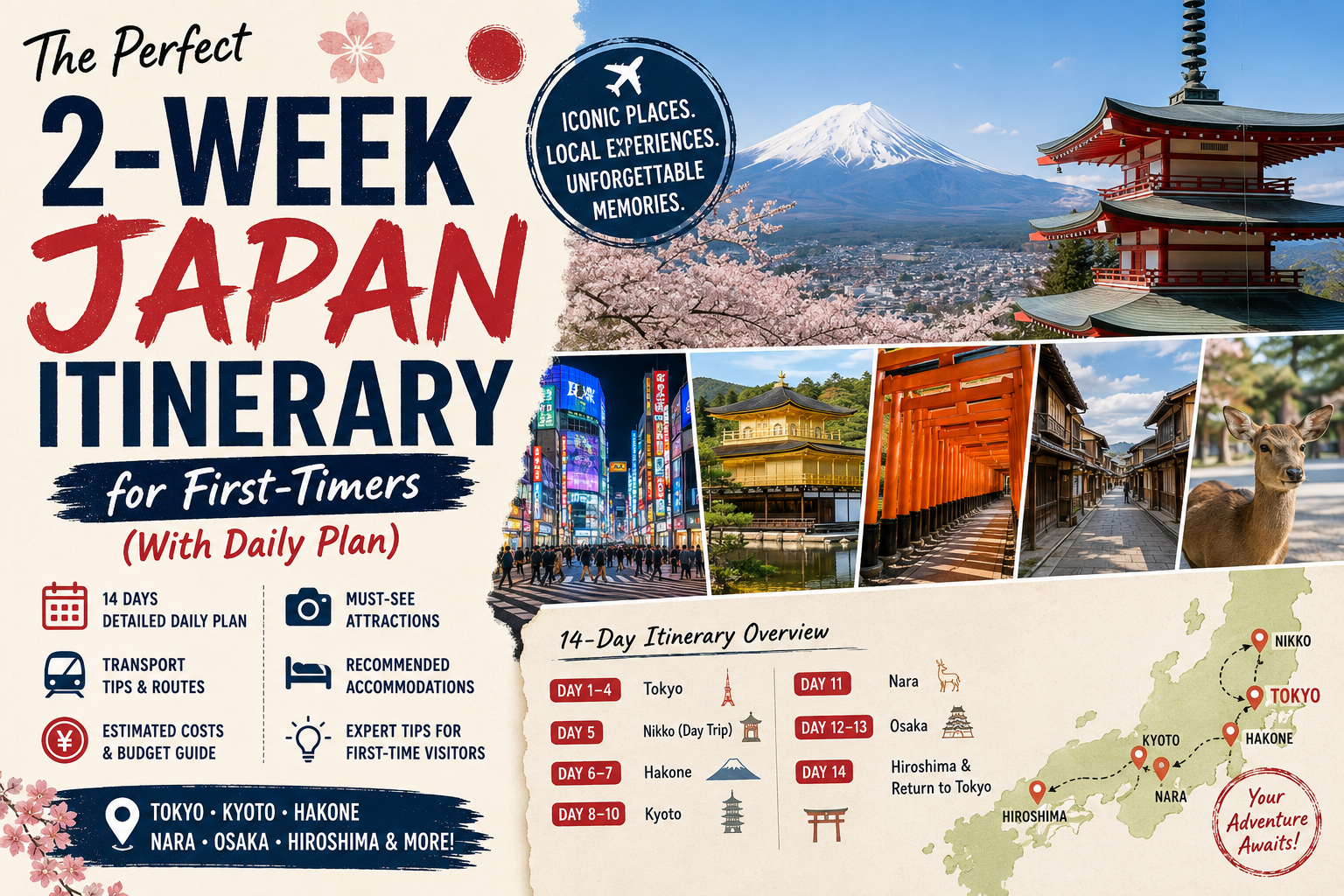
Japan rewards even a first-time visitor with extraordinary generosity. In just two weeks it is possible to experience the neon energy of Tokyo, the sacred serenity of Kyoto’s temples, the thunderous drama of Hakone’s volcanic landscape, the deer-filled avenues of ancient Nara, the street-food paradise of Osaka, and the profoundly moving peace memorials of Hiroshima — all connected by one of the world’s most efficient high-speed rail networks.
This detailed 14-day itinerary for first-time visitors to Japan is designed to give you the perfect balance of iconic sights, off-the-beaten-path discoveries, cultural depth, and practical convenience. Every entry includes transport details, suggested accommodation, admission costs, and specific tips for making the most of each day in 2026.

Days 1–4: Tokyo — Gateway to Modern Japan
Day 1: Arrival and Shinjuku Orientation
Arrive at Narita or Haneda Airport and make your way to your Tokyo hotel. If arriving before 2 p.m., head to Shinjuku for your first evening in Japan. The west side of Shinjuku contains Tokyo’s most dramatic skyline, the iconic Tokyo Metropolitan Government Building (free observatory, open until 10:30 p.m.), and dozens of yakitori and ramen restaurants beneath the railway tracks of Memory Lane (Omoide Yokocho). Allow yourself to simply absorb the overwhelming sensory scale of modern Tokyo on this first evening. Jet lag tip: force yourself to stay awake until 9 p.m. local time on your arrival day; this single discipline will set your body clock correctly for the rest of the trip.
Day 2: Central Tokyo — Asakusa, Akihabara, and Harajuku
Start early at Senso-ji Temple in Asakusa (free admission; arrive before 8 a.m. for quiet and great photos before the tourist crowds). Walk the historic Nakamise shopping street for traditional snacks and souvenirs, then take the Tokyo Metro to Akihabara for Japan’s electronics and pop culture district. Afternoon in Harajuku: Takeshita-dori for youth street fashion, then the serene Meiji Jingu Shrine in the adjacent forested park (free). Evening in Shibuya for the world-famous scramble crossing, dinner in the Shibuya or Daikanyama area.
Transport tip: The Tokyo Metro/Toei day pass (¥900) covers all metro and Toei subway lines — excellent value for a day of cross-city exploration.
Day 3: Ueno, Yanaka, and Tokyo National Museum
Tokyo National Museum in Ueno houses the world’s largest collection of Japanese art and artifacts (¥1,000 admission). Allow 2–3 hours. After the museum, walk through Yanaka — Tokyo’s best-preserved old neighborhood with traditional temples, wooden shopfronts, and a genuine historical atmosphere that feels a world away from the glass towers of the modern city. Evening back in Shinjuku’s Golden Gai (Kabukicho area) for tiny atmospheric bars with 5 to 10-seat capacity.
Day 4: Odaiba and TeamLab Digital Art
teamLab Planets or teamLab Borderless (the new Azabudai Hills location) in Tokyo are extraordinary immersive digital art experiences that have become one of the most talked-about visitor attractions in Asia. Advance tickets are essential (¥3,200 to ¥4,000 per adult; book online at least 2 weeks ahead). Combine with a walk along the Odaiba waterfront and views of Rainbow Bridge and the Tokyo skyline. Return via the scenic Yurikamome monorail line for elevated views of Tokyo Bay.
Day 5: Nikko — Ornate Shrines and Mountain Waterfalls
Nikko in Tochigi Prefecture is one of Japan’s most visually extravagant historic sites — and just 2 hours from Tokyo by direct limited express train. The Tosho-gu Shrine complex is a breathtaking assemblage of ornately decorated halls, gates, and pagodas set within a cedar forest, built in the early 17th century to enshrine the founder of the Tokugawa shogunate. The shrine complex admission is ¥1,300 per adult. Nearby Ryuzu Waterfall (free) and Kegon Falls (¥570 elevator to base) add natural drama to the cultural riches.
Transport from Tokyo: Tobu Nikko Line from Asakusa Station — the Revaty limited express runs 1 hour 50 minutes direct (from ¥2,720 round trip including seat reservation). Return to Tokyo in the early evening for a final Tokyo night before departing south the next morning.
Alternative: Kamakura. If you prefer giant Buddhist statues and coastal scenery to ornate mountain shrines, substitute Kamakura (1 hour from Tokyo by JR Yokosuka Line, ¥920 one way) on this day instead. The Great Buddha of Kotoku-in (¥300) and the cliff-carved Buddhist temples of Hase are outstanding.
Days 6–7: Hakone — Mount Fuji Views and Hot Springs
Day 6: Arriving in Hakone, Owakudani, and Gora
Hakone is Japan’s premier mountain resort area, best known for clear-day views of Mount Fuji and a network of hot spring towns. The Hakone Free Pass (¥6,500 for 2 days from Shinjuku, or ¥5,000 from Odawara) covers the Odakyu Romance Car train from Shinjuku, the Hakone Tozan railway, ropeway, lake cruise, and buses — representing excellent value. Arrive in the afternoon, take the Hakone Tozan ropeway to Owakudani (volcanic valley with active sulfur fumaroles; ¥1,000 round trip without Free Pass), and reach your accommodation in Hakone-Yumoto or Gora by evening.
Accommodation: Hakone has excellent ryokan (from ¥20,000 per night with dinner and breakfast including onsen access) and budget guesthouses (from ¥8,000). The ryokan experience — yukata robes, multi-course kaiseki dinner, private outdoor hot spring bath — is one of the highlights of any Japan trip and Hakone is one of the easiest places to experience it.
Day 7: Hakone Open Air Museum and Lake Ashinoko Cruise
Morning at the Hakone Open Air Museum (¥1,800 admission), one of Japan’s finest outdoor sculpture parks with works by Henry Moore, Picasso, and leading Japanese sculptors set against mountain scenery. Then the Lake Ashinoko cruise across the volcanic caldera lake (¥1,200 one way, covered by Hakone Free Pass) for the iconic Mount Fuji-over-the-lake view if weather cooperates. Afternoon train onward to Kyoto via Odawara and the Tokaido Shinkansen (about 2 hours 20 minutes, Hikari service ¥7,710; covered by JR Pass).
Days 8–10: Kyoto — Japan’s Cultural Capital
Day 8: Eastern Kyoto — Higashiyama and Gion
Start with Fushimi Inari Taisha at dawn (free; nearest station: JR Inari, 5 minutes from Kyoto Station) for the mountain shrine’s thousands of vermilion torii gates before crowds arrive. Return to Kyoto for the Higashiyama walking course: Kiyomizudera Temple (¥500 admission; the famous wooden stage over the hillside), the historic stone-paved lanes of Ninenzaka and Sannenzaka, and the Gion district for the possibility of spotting a geiko (Kyoto geisha) between 5 and 7 p.m. along Hanamikoji-dori.
Day 9: Central and Northern Kyoto — Temples and Bamboo
Morning at Arashiyama: the bamboo grove (free; arrive before 7:30 a.m.), Tenryu-ji Garden (¥500), and the monkey park above Togetsukyo Bridge (¥550). Afternoon at Kinkaku-ji (the Golden Pavilion; ¥500) and Ryoan-ji (the famous rock garden; ¥600). Evening stroll along the Philosopher’s Path (free) as autumn leaves fall into the canal or cherry blossoms drift over the path in spring season.
Day 10: Nijo Castle, Nishiki Market, and Pontocho
Nijo Castle (¥1,300 admission) — Tokugawa shogunate palace with famous nightingale floors that squeak to detect intruders. Walk through the Nishiki Market (Kyoto’s Kitchen) for tastings of Kyoto pickles, tofu dishes, grilled skewers, and matcha sweets. Optional afternoon side trip to Uji (30 minutes south; the world’s finest matcha source, ¥240 by JR) or additional temple visits. Evening dinner in the atmospheric Pontocho alley along the Kamogawa River.
Day 11: Nara — Ancient Capital and Sacred Deer
Nara is only 35 to 50 minutes from Kyoto by train (¥720 by JR Yamato-ji Line rapid; ¥570 by Kintetsu express from Kintetsu Kyoto Station) and makes a perfect full-day excursion. Nara Park is home to approximately 1,200 free-roaming sika deer (shika) considered sacred messengers of the Shinto deities. The deer approach visitors for shika senbei deer crackers (sold throughout the park for ¥200 per bunch).
The park’s main temple, Todai-ji, houses the world’s largest bronze Buddha inside the world’s largest wooden building — admission is ¥600 per adult. Allow time for the Kasuga Taisha Shrine (¥500), the Naramachi historic merchant district, and a bowl of kakinoha-zushi (persimmon-leaf sushi, a Nara specialty) before returning to Kyoto for your last night.

Days 12–13: Osaka — Japan’s Kitchen and Entertainment Capital
Day 12: Dotonbori, Kuromon Market, and Shinsekai
Osaka is Japan’s most enthusiastic food city and the antidote to Kyoto’s serenity. The Dotonbori canal district is the neon-blazing heart of Osaka’s famous eating culture — takoyaki (octopus balls), okonomiyaki (savory pancakes), kushikatsu (skewered and deep-fried everything), and the freshest tuna sashimi you have ever tasted. Walk from Dotonbori to the Kuromon Ichiba Market (Osaka’s Kitchen) for fresh seafood, street food, and the finest grilled wagyu beef skewers. Evening in Shinsekai for the retro 1950s atmosphere and the local specialty Osaka-style kushikatsu.
Transport from Kyoto: JR Biwako-Sanyo Line rapid from Kyoto Station to Osaka Station (18 minutes, ¥580). The Osaka 1-Day Pass (¥820) covers all city subway and tram lines.
Day 13: Osaka Castle, Umeda Sky Building, and Final Night
Osaka Castle (¥600 admission to the main tower with its excellent museum of the Sengoku period civil wars) is best visited on a weekday morning before tour groups arrive. Afternoon in Umeda — the floating garden observatory atop the Umeda Sky Building (¥1,500; an open-air rooftop walkway between two skyscrapers with panoramic city views) is one of Osaka’s most spectacular and underrated experiences. Final evening in Dotonbori for last-night dinner and street food indulgence.
Day 14: Hiroshima and Miyajima — The Most Moving Day of the Trip
Hiroshima deserves a full day and an emotionally open mindset. The Hiroshima Peace Memorial Park and Museum (¥200 admission) is one of the world’s most important and powerful historical sites — the museum documents the human consequences of the atomic bombing of August 6, 1945 with unflinching directness. Allow at least 2 to 3 hours for the museum and the outdoor memorials including the Atomic Bomb Dome (a UNESCO World Heritage Site).
After the memorial, take the JR San’yo Line or ferry to Miyajima Island (20 minutes from Hiroshima by train + ferry, ¥1,840 round trip for both; the ferry is covered by JR Pass). The island is famous for the Itsukushima Shrine’s floating torii gate — the most photographed shrine gate in Japan, appearing to float above the sea at high tide (the gate itself is currently under restoration scaffolding, which may continue into 2026; check current status before visiting). Return to Tokyo by Shinkansen (Nozomi, 4 hours; from ¥19,550; covered by JR Pass on Hikari service).

Complete 2-Week Japan Budget Breakdown for 2026
| Category | Budget (per person) | Mid-Range (per person) | Luxury (per person) |
|---|---|---|---|
| Accommodation (14 nights) | ¥70,000–¥100,000 | ¥120,000–¥180,000 | ¥250,000–¥500,000 |
| JR Pass (14-day) | ¥80,000 | ¥80,000 | ¥80,000 (or private taxi) |
| Local transport (metro, bus) | ¥15,000–¥20,000 | ¥15,000–¥25,000 | ¥20,000–¥40,000 |
| Food and drinks | ¥40,000–¥60,000 | ¥70,000–¥100,000 | ¥150,000–¥300,000 |
| Admission fees | ¥15,000–¥20,000 | ¥20,000–¥30,000 | ¥30,000–¥60,000 |
| Shopping and souvenirs | ¥10,000–¥20,000 | ¥20,000–¥50,000 | ¥50,000–¥200,000 |
| Miscellaneous | ¥5,000–¥10,000 | ¥10,000–¥20,000 | ¥20,000–¥50,000 |
| Total (excl. flights) | ¥235,000–¥330,000 | ¥335,000–¥485,000 | ¥600,000–¥1,230,000 |
Transport and the JR Pass: What You Need to Know in 2026
The Japan Rail Pass is the backbone of long-distance travel on this itinerary. The 14-day pass (¥80,000 per adult in 2026) covers:
- All Shinkansen services on the Tokaido, Sanyo, and Tohoku lines (Hikari and Kodama; NOT Nozomi or Mizuho which are the fastest services)
- Most JR regional and local trains throughout Japan
- The Miyajima ferry between Miyajima-guchi and Miyajima Island
- Some JR bus routes and limited express services
The JR Pass does not cover Tokyo Metro/Toei subway lines, the Nikko Tobu Line, Hakone transportation (use the separate Hakone Free Pass), non-JR local trains, or city buses. A prepaid Suica or Pasmo IC card (available from vending machines at any major station) handles all non-JR transport seamlessly and is accepted for payment at most convenience stores, vending machines, and many restaurants.
Insider Tips for First-Time Japan Travelers
- Cash is still essential in Japan. Despite increasing card acceptance, many traditional restaurants, small guesthouses, temples, and markets are cash-only. Withdraw yen at 7-Eleven or Japan Post ATMs (both reliably accept international cards). Budget ¥50,000 to ¥80,000 in cash for the trip.
- Get a pocket Wi-Fi or SIM card at the airport. Unlimited data pocket Wi-Fi devices can be rented from the airport arrivals hall (approximately ¥600 to ¥800 per day). Alternatively, purchase a Japan travel SIM from IIJmio, mineo, or major carriers — significantly cheaper for stays of 2 weeks or more.
- Download Google Maps offline for every city you visit before you arrive. Japan’s urban transit systems are complex and even experienced travelers rely heavily on navigation assistance to avoid wrong turns.
- Book popular experiences well in advance. teamLab, the Ghibli Museum, Disneyland and DisneySea (see our complete guide to Tokyo Disney parks), and certain Kyoto restaurants require booking weeks or months ahead.
- Learn four Japanese phrases. Sumimasen (excuse me), arigatou gozaimasu (thank you), eigo ga hanasemasu ka? (do you speak English?), and kore wo kudasai (I’ll take this one, said while pointing) — these four phrases will carry you remarkably far and will earn you considerable goodwill from locals.
- The early riser always wins in Japan. At every major tourist site from Arashiyama to Fushimi Inari to Nara Park, the first 90 minutes after opening offer an entirely different and dramatically superior experience compared to the midday crowd.
Also explore: 10 Magical Places in Japan and our guide to Japan’s Best Cherry Blossom Spots for destinations you can add to this base itinerary.
Frequently Asked Questions About a First-Timer Japan Trip
- Is the Japan Rail Pass worth buying for a 2-week trip in 2026?
- Yes, for the itinerary described in this guide. The key routes covered by the JR Pass on this itinerary — Tokyo to Nikko (partial), Tokyo to Hakone (via Odawara), Hakone to Kyoto, Kyoto to Osaka, Osaka to Hiroshima, and Hiroshima back to Tokyo — total well over ¥80,000 in individual Shinkansen fares when calculated at 2026 prices. The break-even point is typically reached if you make three or more long-distance Shinkansen journeys. Calculate your specific route at the JR fare calculator (hyperdia.com or the official JR website) before purchasing.
- Is Japan safe for solo travelers and families with children?
- Japan is consistently ranked as one of the safest countries in the world for all types of travelers. Crime rates are extremely low, public transport is clean and reliable, and Japan is famously hospitable to international visitors. Families with young children will find Japan particularly well-suited: children’s menus are common, department store family rooms are excellent, and attractions like Nara’s deer park, Tokyo Disneyland, and teamLab digital art are genuinely wonderful for kids of all ages. Solo travelers — of all genders — report Japan as consistently one of their most comfortable and stress-free travel experiences.
- How much Japanese do I need to speak to enjoy the trip?
- Remarkably little, though any effort at Japanese is warmly received. English signage and menus are increasingly common at major tourist destinations, train stations, airports, and convenience stores throughout Japan. Google Translate’s camera function handles most menus and signs that aren’t available in English. The most useful tools are: a translated restaurant ordering system (point at pictures), a good navigation app, and the four basic phrases listed in the tips section above.
- What is the best time of year to do this 2-week itinerary?
- This itinerary works well in any season, but the three best periods are: late March to mid-April (cherry blossom season — most romantic and atmospheric, but accommodation books out months in advance); October to mid-November (autumn foliage — arguably the most beautiful season for temple gardens, cooler weather, no rain); and September (post-summer, before peak autumn, good weather, fewer crowds, lower prices). Avoid mid-July through August (hot and extremely humid) and major Japanese public holidays (Golden Week in late April to early May, Obon in mid-August, New Year holidays) when hotels are expensive and crowded.
- Should I visit Nikko or Kamakura on Day 5?
- It depends on your interest. Choose Nikko if you are drawn to ornate Edo-period architecture in a dramatic mountain forest setting, and if you enjoy hiking to waterfalls and seeing the natural drama of a volcanic plateau. Choose Kamakura if you prefer a coastal atmosphere, want to see the Great Buddha statue (a truly imposing presence), and enjoy temple-hopping through rolling hillsides with sea views. Kamakura is slightly more accessible and requires less walking than Nikko; Nikko offers more visual extravagance and a stronger sense of historic grandeur.
Verdict: Is Two Weeks Enough for Japan?
For enchanting side trips to add to this itinerary, see our guides: 10 Magical Places in Japan That Feel Like a Fairytale | How to Plan a Ghibli-Inspired Trip to Japan | Tokyo Disneyland vs DisneySea 2026 Guide.