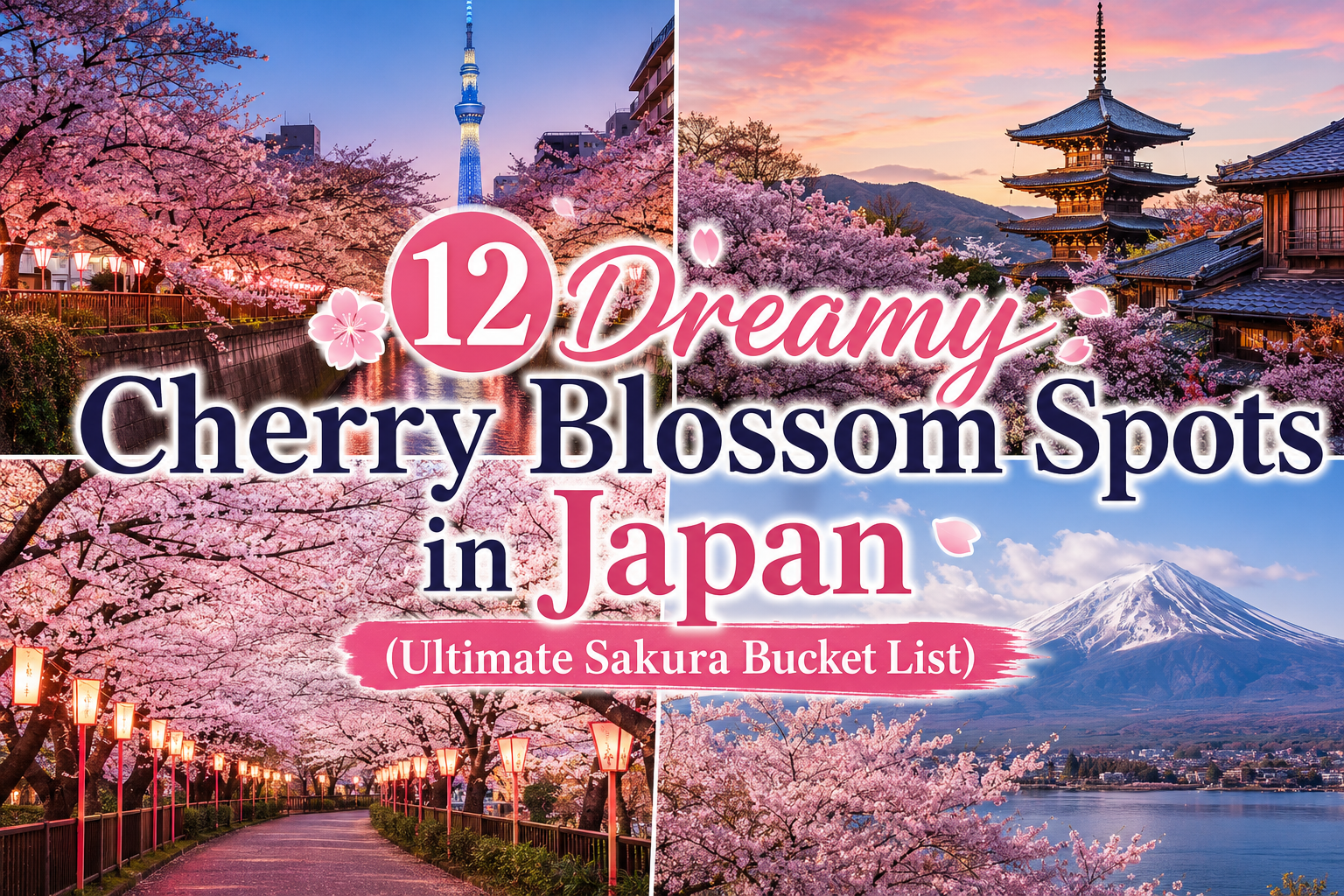
Japan’s cherry blossom season is one of the most spectacular natural events on the planet. Each spring, millions of sakura trees erupt simultaneously in waves of soft pink and white, transforming cities, castle grounds, mountain slopes, and river banks into ethereal dreamscapes. The Japanese tradition of hanami — flower viewing — has been celebrated for over 1,000 years, and the national enthusiasm for cherry blossoms remains undiminished today.
But with thousands of cherry blossom spots scattered across the Japanese archipelago, choosing where to go can be overwhelming. This guide cuts through the noise with 12 genuinely outstanding cherry blossom destinations — from iconic urban river walks to remote mountain hamlets where thousands of trees cascade down hillsides like a pink waterfall. All information is updated for the 2026 sakura season.

Tokyo’s Best Sakura Spots: Urban Cherry Blossoms at Their Most Dramatic
1. Meguro River, Nakameguro, Tokyo
For urban atmosphere and sheer romantic drama, Meguro River in Nakameguro, Tokyo is hard to beat. Approximately 800 cherry trees line the narrow river canal for nearly 4 kilometers, their branches arching over the water to form a complete pink canopy that reflects perfectly in the dark surface below. At night the trees are illuminated by hundreds of paper lanterns, creating one of the most photographed scenes in all of Tokyo.
The riverbank is lined with cafes, restaurants, and boutique shops that spill their menus onto the footpaths during blossom season. Admission is free, though the surrounding Nakameguro neighborhood is upmarket and dining prices reflect it. Best time to visit: the final week of March to early April when blossoms are at their peak. Arrive before 9 a.m. or after 7 p.m. on weekdays to avoid the most intense daytime crowds. Access: Tokyu Toyoko Line or Tokyo Metro Hibiya Line to Nakameguro Station (direct from Shibuya in 5 minutes).
2. Chidorigafuchi, Tokyo
Set in the moat of the Imperial Palace in central Tokyo, Chidorigafuchi is the capital’s most graceful cherry blossom experience. Approximately 260 cherry trees — predominantly Somei Yoshino and Oshima varieties — line the moat walls, and visitors can rent rowboats to drift through a pink tunnel of overhanging blossoms directly from the water. Petals drift down onto the boats and into the olive-green water in small drifting islands of pink.
Rowboat rental costs ¥800 per person for 30 minutes. The promenade path along the moat is free and approximately 700 meters long. The cherry trees here are old and grand, and during the day the white stone of the Imperial Palace walls provides an elegant contrast to the vivid pink blossoms. Access: Tokyo Metro Hanzomon Line to Hanzomon Station (2 minutes on foot); or Toei Shinjuku Line to Ichigaya Station (10-minute walk).
3. Shinjuku Gyoen National Garden, Tokyo
Shinjuku Gyoen is the most diverse cherry blossom destination in Tokyo. The 58-hectare garden contains approximately 1,000 cherry trees spanning over 75 varieties, meaning the garden’s blossom season runs from early March (early-blooming Kanzakura varieties) to late April (late-blooming Ichiyo and Ukon varieties) — the longest sakura window of any single site in the capital. The combination of a formal French parterre garden, an English landscape garden, and a traditional Japanese garden creates a uniquely varied backdrop.
Admission is ¥500 per adult, and alcohol is prohibited inside — making it significantly calmer than the famous but chaotic Ueno Park hanami gatherings nearby. Best time to visit: Late March to early April for peak Somei Yoshino bloom. Lines can form at the gates during weekend peak bloom; arriving at opening (9 a.m.) minimizes waiting. Access: Tokyo Metro Marunouchi Line to Shinjuku Gyoenmae Station (3 minutes’ walk to the Shinjuku Gate).
Kyoto’s Classic Cherry Blossom Experiences
4. Maruyama Park, Kyoto
The spiritual home of Kyoto hanami, Maruyama Park is the city’s most beloved cherry blossom gathering place. At its center stands the iconic shidare-zakura — a massive weeping cherry tree that has been the park’s symbol for over a century. The tree’s cascading pink branches are illuminated after dark against the black sky, and the scene is genuinely one of the most beautiful and atmospheric in all of Japan during peak bloom.
The park fills with crowds of picnickers, food stalls, and performers during blossom season — this is hanami at its most traditionally Japanese and festive. Entry to the park is free, though the atmosphere varies dramatically depending on the time of day. Visit at dusk for the most magical light conditions. Access: City Bus to Gion or Chion-in bus stops (5 to 10-minute walk from either). Combine with a visit to neighboring Yasaka Shrine and the Gion entertainment district for a full day.
5. Philosopher’s Path (Tetsugaku-no-Michi), Kyoto
Running for approximately 2 kilometers along a canal lined with over 450 cherry trees in the Higashiyama hills, Philosopher’s Path in Kyoto is one of Japan’s most serene and culturally resonant cherry blossom walks. The path is named after philosopher Nishida Kitaro, who is said to have walked it daily in meditation. The canal reflects the hanging blossoms, the stone paths and moss-covered walls provide an authentically historic setting, and the route passes numerous small temples, cafes, and art galleries.
The path is entirely free to walk. Peak bloom typically falls in late March to early April. Visit early morning (before 8 a.m.) for genuine tranquility — by mid-morning the narrow path becomes densely crowded on weekends. Access: City Bus to Ginkakuji-michi stop (the northern end of the path) or Nanzenji-Eikando-michi stop (the southern end). The walk connects naturally with Ginkakuji (Silver Pavilion) at the northern terminus.
Castle Sakura: Japan’s Most Dramatically Beautiful Settings
6. Himeji Castle, Hyogo Prefecture
Japan’s finest surviving feudal castle, Himeji Castle (UNESCO World Heritage) is often called the White Heron Castle for its brilliant white facade. When the castle’s grounds erupt in cherry blossoms each spring, the contrast between the blazing white towers and the deep pink sakura clouds surrounding them creates one of the most visually stunning compositions in all of Japanese photography.
Approximately 1,000 cherry trees fill the grounds and outer moats. Castle admission costs ¥1,000 per adult; viewing from the ground outside the castle walls is free and offers some of the best photographic angles. Best time: late March to early April. The castle is busiest on weekends during peak bloom. Visit on a weekday morning and arrive at gate opening (9 a.m.) for the best experience. Access from Tokyo: Tokaido Shinkansen to Shin-Osaka (2.5 hours, from ¥14,720), then JR Special Rapid to Himeji (50 minutes, ¥1,520). Total journey approximately 3.5 hours.
7. Hirosaki Castle, Aomori Prefecture
For sheer volume and visual extravagance, Hirosaki Castle in Aomori rivals and arguably surpasses any cherry blossom spectacle in the country. The castle grounds contain approximately 2,600 cherry trees — predominantly Somei Yoshino — and when they bloom together in late April the castle and its moats disappear entirely beneath a canopy of pink. The famous floating pink carpet effect, when fallen petals cover the surface of the moats completely, creates a scene of extraordinary beauty.
Entrance to the castle grounds (excluding the castle tower itself) costs ¥320 per adult; the famous hanami festival runs during peak bloom in late April and includes food stalls, traditional performances, and extended evening illuminations. Note: Hirosaki sakura blooms significantly later than Kyoto and Tokyo, typically peaking in late April to early May — perfect for extending your Japan sakura season experience. Access from Tokyo: Tohoku Shinkansen to Shin-Aomori (about 3 hours 10 minutes, from ¥17,470), then JR Ou Line to Hirosaki (30 minutes, ¥510).
8. Takato Castle Ruins, Nagano Prefecture
Known throughout Japan as the home of the most beautiful cherry blossoms in the country, Takato Castle Ruins Park (Takato-jo Shi Koen) in Ina, Nagano is something of a pilgrimage site for dedicated sakura hunters. The park contains approximately 1,500 trees of the rare Takato Kohigan variety — a small-flowered, intensely deep-pink cherry unique to this park. During peak bloom the entire hillside blazes in a color closer to magenta than the usual pale pink, creating a spectacular and surprisingly other-worldly visual effect.
Admission to the castle park is ¥300 per adult during bloom season (free outside of sakura season). Peak bloom typically falls in early to mid-April, slightly later than in the Kanto plain. Crowds gather on weekends; weekday mornings are much more peaceful. Access: JR Chuo Line from Shinjuku to Iida Line to Ina-shi Station (about 3.5 hours, from ¥6,600), then bus or taxi to the park. A rental car from Nagano or Matsumoto is the most convenient option.
Mountain and Rural Sakura: Japan’s Most Epic Cherry Blossom Landscapes
9. Yoshino Mountain (Yoshinoyama), Nara Prefecture
If one place in Japan embodies the very essence of cherry blossom pilgrimage, it is Yoshino Mountain. Over 30,000 cherry trees — mostly Yamazakura mountain varieties — cover the slopes of Yoshino from the base to the summit, blooming in altitude-staggered waves over several weeks from late March through late April. The mountain has been revered as a sacred sakura site since the 7th century, and Emperor Go-Daigo is said to have admired the blossoms here in 1331.
The mountain is divided into four viewing zones from lowest to highest: Shimo Senbon, Naka Senbon, Kami Senbon, and Oku Senbon. Each zone blooms at slightly different times and offers distinct characters, from crowded lower trails with souvenir shops to the remote upper zones with ancient mountain temples. Access to the mountain itself is free; accommodation at the mountain’s many shukubo temple lodgings costs from ¥12,000 per night with meals. Access: Kintetsu Yoshino Line from Osaka-Abenobashi to Yoshino Station (about 90 minutes direct, ¥1,200), then cable car or walk up the mountain.
10. Kakunodate, Akita Prefecture
Often called the Kyoto of the Tohoku region, Kakunodate is a beautifully preserved samurai castle town in Akita Prefecture whose broad, tree-lined streets are home to approximately 400 weeping cherry trees (shidare-zakura). The trees were brought from Kyoto as gifts by a feudal lord in the Edo period and now line the bukeyashiki (samurai district) streets as a spectacular pink arcade in late April and early May.
The Hinokinai River bank near town is lined with an additional 2 kilometers of Somei Yoshino and other varieties, creating a full day of sakura viewing. Entry to the samurai district streets is free, though many of the historic samurai residences charge ¥300 to ¥500 for interior access. Accommodation in Kakunodate ranges from business hotels to traditional ryokan (from ¥10,000 per night). Access from Tokyo: Akita Shinkansen to Kakunodate Station (about 3 hours, from ¥16,870).
Mount Fuji as a Backdrop: The Ultimate Sakura Power Spots
11. Fuji Five Lakes (Fujigoko), Yamanashi Prefecture
For the quintessential image of Japan — Mount Fuji framed by cherry blossoms — the five lakes surrounding the volcano’s northern base are unrivaled. Lake Kawaguchiko’s north shore hosts the Kawaguchiko Sakura Festival each spring, with approximately 120 Yamazakura cherry trees lining the lakeshore directly opposite Fuji’s snow-capped peak. The scene on a clear morning — reflected pink blossoms, the still lake, and Fuji beyond — is literally the postcard image of Japan.
The lakeshore path is free to walk and approximately 1.5 kilometers long. Cherry blossom season at Fuji Five Lakes typically runs from early to mid-April, slightly later than central Tokyo due to the higher elevation. Accommodation in Kawaguchiko ranges from lakeside ryokan (from ¥15,000 per night with dinner) to budget hostels (from ¥3,500 per person). Access from Tokyo: Direct highway bus from Shinjuku Bus Terminal to Kawaguchiko (about 1 hour 50 minutes, ¥1,750 to ¥2,000 each way). The Fujikyuko Line from Otsuki also connects to Kawaguchiko.
12. Kintai Bridge, Iwakuni, Yamaguchi Prefecture
An elegant five-arched wooden bridge completed in 1673, Kintaikyo Bridge in Iwakuni, Yamaguchi Prefecture is one of Japan’s three most celebrated historic bridges. When approximately 3,000 cherry trees bloom along the Nishiki River banks and castle hillside in April, the combination of the arched wooden bridge, Iwakuni Castle on the hill above, and the cascading cherry blossoms creates one of the most compositionally perfect spring scenes in western Japan.
Bridge crossing costs ¥310 per adult (or ¥940 for a bundle ticket including the castle ropeway and castle admission). The castle hilltop viewpoint offers a dramatic overhead view of the bridge surrounded by sakura that is widely considered one of the best sakura photographs in all of Japan. Access: JR San’yo Shinkansen to Shin-Iwakuni Station, then bus to Kintaikyo (about 15 minutes, ¥250). From Hiroshima, it is approximately 45 minutes by highway bus direct to the bridge.
Japan Cherry Blossom Season: Timing and Bloom Forecast Guide
Cherry blossom timing in Japan follows a predictable geographic pattern driven by temperature and latitude, moving from south to north and from low to high elevation across the spring season. Here is a reliable reference table for planning your 2026 sakura trip:
| Region / City | Typical Peak Bloom | Key Spot | Alt-Spot for Late Bloomers | 2026 Forecast |
|---|---|---|---|---|
| Kyushu (Fukuoka, Kumamoto) | Late March | Maizuru Park | Castle grounds | March 25–April 3 |
| Tokyo and Kanto | Late March to early April | Meguro River, Chidorigafuchi | Shinjuku Gyoen | March 28–April 7 |
| Kyoto and Kansai | Late March to early April | Maruyama Park | Yoshino (late April) | March 30–April 10 |
| Kanazawa and Chubu | Early April | Kenroku-en Garden | Takato Castle (early April) | April 3–April 13 |
| Tohoku (Sendai, Aomori) | Mid to Late April | Hirosaki Castle | Kakunodate | April 20–May 3 |
| Hokkaido (Sapporo) | Late April to early May | Maruyama Park Sapporo | Goryokaku Fort | April 28–May 8 |
Budget and Cost Guide for Japan’s Cherry Blossom Season
The sakura season is Japan’s busiest and most expensive travel period. Planning ahead is essential to avoid paying peak-season premiums. Here is a realistic budget breakdown:
- Accommodation premium during peak sakura: Expect to pay 30 to 80 percent more than off-peak rates for hotels in Kyoto, Tokyo, and popular sakura towns. A mid-range hotel in Kyoto that costs ¥10,000 on a normal night can reach ¥18,000 during peak bloom weekends.
- Transport: A 14-day JR Pass (¥80,000) is excellent value if you plan to visit multiple sakura regions including Tohoku destinations like Hirosaki and Kakunodate. Book the pass before arriving in Japan at a lower price than at Japanese airports.
- Admission costs: Most public parks are free; castle grounds typically charge ¥300 to ¥1,000 for admission. Budget approximately ¥3,000 to ¥5,000 total in admission fees for the 12 spots on this list.
- Food and sake during hanami: Picnic supplies from a Japanese convenience store (onigiri, sandwiches, sake, beer) cost ¥1,000 to ¥2,000 per person and are a quintessential way to experience hanami culture.
Insider Tips for the Best Sakura Experience in Japan
From timing to technique, here is what experienced Japan cherry blossom travelers wish they had known before their first trip:
- Monitor the JWA sakura forecast. The Japan Weather Association (nihon kishō kyōkai) and several apps publish cherry blossom bloom forecasts updated weekly. Peak bloom (mankai) typically lasts only 5 to 7 days — getting the timing right is the single most important factor in a great sakura trip.
- Best time of day for photos is the first hour after sunrise. The soft pink light of early morning combined with low tourist numbers creates ideal conditions for photography at most spots. The famous Meguro River shot requires pre-dawn arrival on weekends.
- Hanami etiquette: When picnicking under the trees, bring your own trash bags (most parks provide no bins during sakura season) and be mindful of other visitors’ space and enjoyment. Loud music and excessive drinking are frowned upon outside of the designated hanami party areas.
- The week after peak bloom can be just as magical. Falling petals (hanafubuki, or flower blizzard) and floating petal carpets on river surfaces are often considered the most beautiful phase of sakura by seasoned enthusiasts, and crowds thin significantly after the official peak.
- Combine Tohoku destinations with Hirosaki Castle. Since Tohoku blooms 3 to 4 weeks after Tokyo, traveling north from Tokyo during the last week of April allows you to extend your sakura season and discover dramatically less-crowded destinations like Kakunodate and Hirosaki.
For complete trip planning, see our Perfect 2-Week Japan Itinerary which includes optimal timing for the sakura season, and our list of 10 Magical Places in Japan That Feel Like a Fairytale for year-round destination inspiration.
Frequently Asked Questions About Japan’s Cherry Blossom Season
- What is the best time to visit Japan for cherry blossoms in 2026?
- Based on historical averages and climate trends, the ideal window for most of Japan is late March through mid-April 2026. Tokyo and Kyoto typically peak in the last few days of March or first week of April. For northern destinations like Hirosaki Castle (Aomori) and Kakunodate (Akita), the peak is usually late April to early May. Check the Japan Meteorological Corporation’s sakura forecast from early February onward for updated predictions.
- Which cherry blossom spot is the most romantic for couples?
- Meguro River in Nakameguro, Tokyo is almost universally considered the most romantic cherry blossom setting in Japan, especially at night when the illuminated pink canopy reflects in the dark water below. Kintai Bridge in Iwakuni is a close second for couples who prefer a more historic and less urban atmosphere. For ultimate exclusivity, an overnight stay at a ryokan guesthouse in Ine Funaya during hanami season offers cherry blossoms, fresh seafood, and a harbor sunrise combination that rivals anything in the country.
- Can I see cherry blossoms and Mount Fuji at the same time?
- Yes — Lake Kawaguchiko in Yamanashi Prefecture offers the classic combination of Mount Fuji and cherry blossoms from early to mid-April. The north shore of the lake provides the most direct Fuji view behind the blossoms. For a wider panorama, the lakeside Chureito Pagoda at Fujiyoshida (a steep 15-minute uphill walk from Shimoyoshida Station) offers an iconic five-story pagoda, sakura, and Fuji composition that is one of the most reproduced photographs in Japanese tourism.
- Are there any cherry blossom spots that are free to visit?
- Many of Japan’s best cherry blossom destinations are completely free. Meguro River (Tokyo), Chidorigafuchi promenade (Tokyo), Philosopher’s Path (Kyoto), Maruyama Park (Kyoto), Kakunodate samurai district (Akita), and Lake Kawaguchiko shoreline (Yamanashi) all have free access. Rowboat rentals at Chidorigafuchi and some castle admissions carry fees, but you can enjoy the blossoms from outside the paid areas at no cost.
- How many days do I need to see cherry blossoms properly in Japan?
- A dedicated cherry blossom itinerary of 7 to 10 days allows you to experience the full spectrum — Tokyo’s urban river walks, Kyoto’s temple gardens, castle grounds in Himeji or Hirosaki, and the iconic Mount Fuji backdrop at Kawaguchiko. If you can extend to 14 days, continuing north to Tohoku (Hirosaki and Kakunodate) adds two of Japan’s most spectacular and crowd-free sakura experiences at a time when southern Japan’s blossoms have already fallen.
Verdict: Which Sakura Spots Are Worth the Journey?
Plan your spring Japan adventure with our 2-Week Japan Itinerary for First-Timers and discover more year-round magic at our 10 Magical Places in Japan guide.