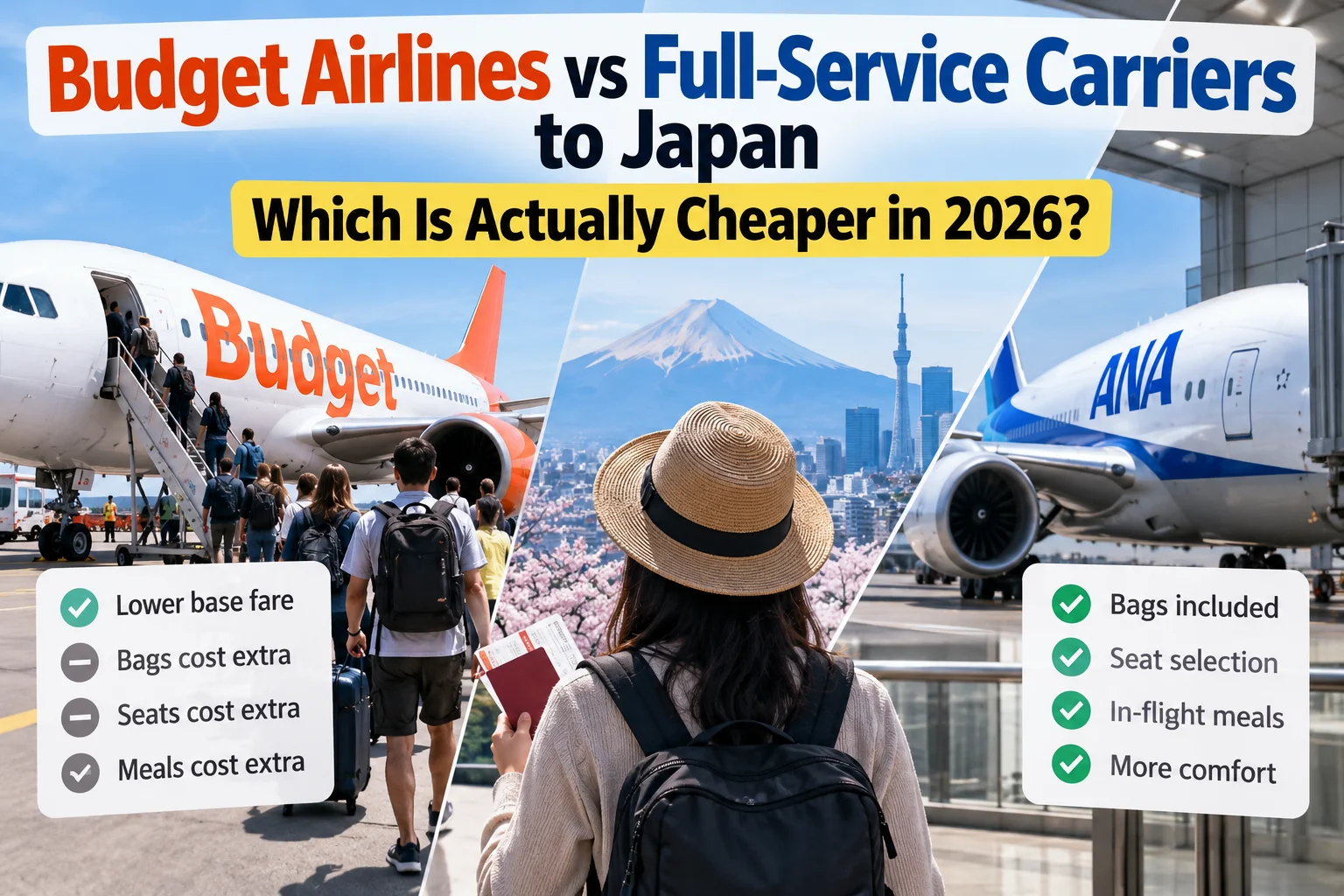
A budget airline ticket to Japan can look $400 to $700 cheaper than a full-service one on the same route, same week. Travelers book it, feel smart, and move on.
Then the add-ons start arriving one at a time, and for a lot of them, the gap that looked decisive at checkout barely exists by boarding.
⭐ Bottom Line
Budget carriers to Japan can save real money on a carry-on-only trip, but bags, seats, and meals routinely close most of a $300+ sticker-price gap by the time you actually fly.
- Best for: One or two travelers flying carry-on only, on a fixed date, who don’t mind a secondary airport
- Budget: $500–$700 round trip (budget, bags extra) vs. $650–$1,200 round trip (full-service, bags included)
- Book ahead: 3–5 months for the best budget-carrier sales; full-service fares move less but reward flexible dates
The direct answer: it depends almost entirely on whether you check a bag. Flying carry-on only, budget carriers to Japan — ZIPAIR, Scoot, AirAsia X, and Jetstar, depending on where you’re departing from — are usually genuinely cheaper, sometimes by a wide margin. Add one checked bag each way, a seat assignment, and a meal, and the total frequently lands within $50 to $150 of a full-service fare that already included all three.
That’s not a reason to avoid budget carriers. It’s a reason to price the trip you’re actually taking, not the fare you saw in the ad.
The Sticker Price Gap Is Real — At First Glance
Start with the number that gets screenshotted and shared: in 2026, ZIPAIR — Japan Airlines’ long-haul budget subsidiary — has run one-way fares from West Coast US cities to Tokyo Narita as low as $258 to $284, with round-trip nonstop deals from cities like San Francisco appearing around $543. Compare that to ANA’s own published economy fares on the same Los Angeles–Tokyo route, which typically run $637 to $1,229 round trip depending on season, occasionally dropping to promotional lows near $408 to $536.
Winner on base fare alone: budget carriers — but that number rarely survives contact with an actual packing list.
What Budget Carriers Don’t Show You Until Checkout
Budget carriers don’t build the cost into one ticket. They build the trip piece by piece — a bag here, a seat there, a meal on top. That’s not a hidden trick; it’s the business model. ZIPAIR’s cheapest fares include only 7 kg of carry-on baggage — nothing checked, no seat assignment, no meal. Add a checked bag and travelers on ZIPAIR’s own booking forums have reported paying $70 to $167 for a single checked bag, depending on the route and whether it’s booked in advance or at the airport. One traveler on a deal-tracking forum described a $544 round-trip ZIPAIR fare from San Francisco climbing to roughly $900 once a checked bag, seat selection, and a meal were added for one passenger.
The pattern isn’t unique to ZIPAIR. Scoot’s published fare structure runs three tiers — Fly (seat only), FlyBag (seat plus 15 kg checked), and FlyBagEat (seat, bag, and a hot meal) — and travelers comparing AirAsia and Jetstar on Asia–Japan routes have reported checked-bag fees ranging from roughly $35 to $75 each way depending on carrier and how far ahead it’s booked.
The Real Total Cost, Side by Side
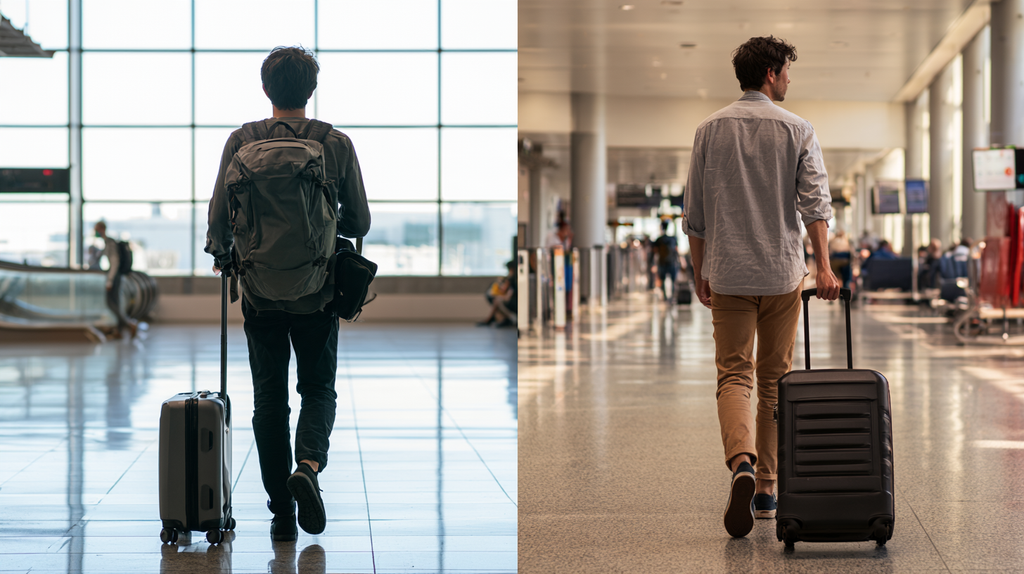
Here’s what a realistic round trip for one traveler looks like once the extras are added back in, based on 2026 published fares and reported add-on pricing for a typical US–Tokyo route:
| Cost Item | Budget Carrier (ZIPAIR/Scoot-style) | Full-Service Carrier (ANA/JAL/United) | Notes |
|---|---|---|---|
| Base round-trip fare | $520–$580 | $650–$950 | Budget fare includes only a personal item; full-service includes carry-on + 1 checked bag |
| 1 checked bag (round trip) | +$140–$300 | Included | Budget carriers charge per direction; return leg is often priced in JPY, sometimes cheaper |
| Seat selection | +$20–$60 | Often included in standard economy | Full-service carriers usually assign a seat free unless it’s extra-legroom |
| One hot meal each way | +$15–$35 | Included | Budget carriers sell meals à la carte or require pre-order |
| Realistic total | $695–$975 | $650–$950 | Ranges overlap more than the base fares suggest |
The unexpected comparison: once bags, seats, and food are priced in, a “cheap” budget fare and a mid-range full-service fare on the same route can land within $50 of each other — sometimes with the full-service ticket coming out slightly ahead once you count the value of an included bag most travelers were going to need anyway.
Walk through an actual booking and the gap closes fast. Say a budget fare shows up at $550. You book it, feeling good about beating the $850 full-service option by $300. Then the real trip shows up: a 10-day itinerary means clothes, shoes, and whatever you buy while you’re there, so you add a checked bag — call it +$150. You’d rather not gamble on airport food for an 11-hour flight, so you add a meal — +$40. Your assigned seat turns out to be a middle seat three rows from the galley, so you pay for a better one — +$30. That $550 fare is now $770. The “expensive” $850 full-service ticket just became a $80 gap instead of a $300 one — and it already included all three.
Schedule, Airports, and What Happens When Something Goes Wrong
Budget carriers to Japan frequently fly into secondary airports — ZIPAIR uses Narita rather than the more central Haneda for most North American routes — which can add 60–90 minutes of train time into central Tokyo. Full-service carriers split between both airports, with more Haneda options overall.
Flexibility is the other quiet cost. Full-service carriers generally allow date changes for a fee plus fare difference, and many premium credit cards include trip protections that apply to them. Budget carriers are stricter by design: many long-haul low-cost fares are non-changeable or carry high change fees, and irregular-operations rebooking (if a flight is delayed or cancelled) is typically slower and less generous than what a full-service carrier’s larger network can absorb.
None of this makes budget carriers unreliable — most travelers who fly ZIPAIR, Scoot, or similar carriers to Japan report smooth, on-time experiences, and airport staff are generally used to explaining the bag-weighing and check-in process to first-time long-haul-budget flyers. The real difference shows up only when something goes wrong: a full-service carrier’s larger network of same-day alternate flights simply isn’t something a smaller budget operation can match.
Where Full-Service Carriers Quietly Win

Beyond flexibility, full-service carriers on Japan routes typically include a full meal service, more generous baggage as standard, frequent-flyer miles that can matter for a future trip, and in ANA and JAL’s case, a stronger domestic network if your Japan trip includes a connecting flight to Sapporo, Fukuoka, or Okinawa — where budget-carrier coverage is thinner. For travelers checking two bags each and valuing a predictable, all-in price over a hunt for the lowest possible number, full-service is usually the less stressful — and not necessarily more expensive — option.
There’s also a currency quirk worth knowing about: because budget-carrier add-ons like ZIPAIR’s checked-bag fees are sometimes charged in Japanese yen on the return leg, travelers have reported paying noticeably less for the same bag heading home than they did flying out. It’s a small, genuine oddity of how these fares are built — not a discount, just a currency-conversion side effect that occasionally works in your favor and is worth checking before you assume the return leg will cost the same as the outbound one.
Who Should Choose Which
Picture landing in Tokyo already knowing exactly what the trip cost you, no surprise line items waiting at check-in, one bag already checked through with your name on it.
That peace of mind has a real price tag — sometimes $50, sometimes closer to $200 — and whether it’s worth paying depends entirely on how you actually pack.
Budget carriers win if you’re traveling carry-on only, your dates are fixed, and you’re comfortable with a secondary airport and no safety net if plans change. Full-service carriers win if you’re checking bags anyway, want mileage-earning potential, need date flexibility, or you’re connecting onward to a smaller Japanese city.
✅ Choose a Budget Carrier If You Are:
- Flying with only a carry-on and a personal item
- Locked into fixed, non-negotiable travel dates already
- Comfortable landing at Narita instead of Haneda
- Booking well ahead to catch a fare sale rather than last-minute
- Traveling solo or as a pair splitting minimal luggage
❌ Skip the Budget Carrier If You Are:
- Checking one or more bags per person regardless of fare type
- Traveling with a tight, non-flexible connection on either end
- Hoping to earn or redeem frequent-flyer miles
- Connecting onward to a smaller Japanese city with thin budget-carrier coverage
- Uneasy about limited rebooking options if a flight is disrupted
- Is ZIPAIR actually owned by Japan Airlines?
- Yes. ZIPAIR is a wholly owned long-haul low-cost subsidiary of Japan Airlines, operating its own fleet and fare structure separately from JAL’s full-service tickets.
- How much does a checked bag really cost on a budget carrier to Japan?
- Based on 2026 traveler-reported pricing, expect roughly $70 to $167 per checked bag on North American budget routes to Japan, and lower ranges (roughly $35 to $75) on shorter Asia-Pacific budget routes, with return-leg pricing sometimes cheaper due to currency differences.
- Do full-service carriers to Japan always include a free checked bag?
- Most published full-service fares from the US to Japan on ANA, JAL, and their partner airlines include one free checked bag in standard economy, though this can vary by specific fare class, so it’s worth confirming before booking.
- Which airports do budget carriers use in Tokyo?
- Most long-haul budget routes, including ZIPAIR’s North American flights, use Narita rather than the more central Haneda, which can add roughly 60 to 90 minutes of train or bus time into central Tokyo compared with a Haneda arrival.
- Is it worth paying more for a full-service carrier just for flexibility?
- If your itinerary has a hard connection or deadline on either end, yes — full-service carriers generally offer easier date changes and better rebooking support during delays or cancellations, which can be worth far more than the fare difference if something goes wrong.
Related Guides
- San Francisco to Sapporo, Nonstop for the First Time Ever: What It Means for a Niseko Trip
- Why 2026 Might Be the Cheapest Japan Has Ever Been for US Travelers
- JR Pass or Individual Tickets? The 2026 Math for US Travelers
- How Much Does a 2-Week Japan Trip Really Cost in 2026?
- Americans Are Visiting Japan in Record Numbers Right Now — Here’s Why