
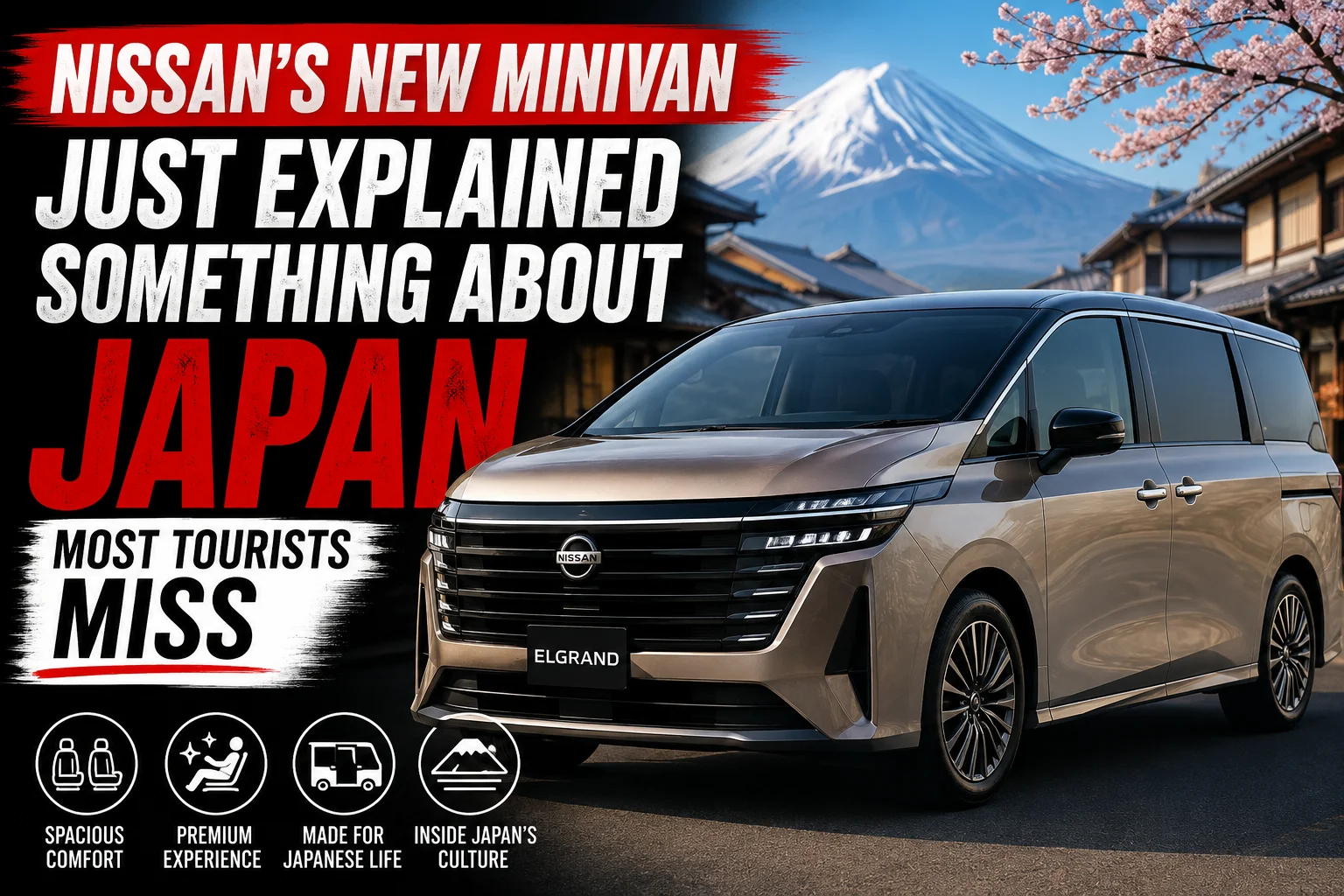
On July 17, Nissan pulled the wraps off a fully redesigned Elgrand minivan — the model’s first complete overhaul in 16 years. For most international readers this barely registers, but for anyone planning a Japan road trip or family visit, it’s a useful entry point into a corner of Japanese car culture that rarely gets explained to outsiders: the luxury minivan, and why it matters so much more here than it does almost anywhere else.
What’s Actually New About the 2026 Elgrand

Nissan unveiled the redesigned Elgrand alongside a new brand message, positioning the launch as part of a broader effort to rebuild the company’s business and revive flagging sales. The Elgrand has long served as Nissan’s flagship full-size minivan in the Japanese domestic market — the kind of vehicle bought by families who want space and comfort, but also by executives, hotels, and premium car services who use it as a chauffeur-driven people-mover. Nissan has not yet confirmed international export plans for the redesigned model, and past Elgrand generations were sold almost exclusively in the Japanese domestic market, which is part of why the vehicle remains unfamiliar to most travelers despite its prominence at home. That gap between domestic prominence and international obscurity is exactly why a routine model launch became notable enough to make English-language headlines at all. A ground-up redesign after 16 years signals Nissan is treating this segment as a genuine priority, not an afterthought model left to age quietly.
A Brief History of the Elgrand

The Elgrand nameplate dates back to 1997, when Nissan introduced it as a more premium alternative to the utilitarian vans that dominated the segment at the time. Over three subsequent generations, it steadily shifted upmarket, adding features like heated leather captain’s chairs, rear-seat entertainment systems, and increasingly car-like ride quality that set it apart from work-oriented vans. The third generation, launched in 2010, ran for an unusually long 16 years without a full redesign — receiving minor facelifts along the way but never the kind of ground-up overhaul the 2026 model represents. That long production run is partly why the new Elgrand’s unveiling generated more domestic buzz than a routine model refresh typically would.
Why This Matters for Nissan
The timing isn’t incidental. Nissan has spent the past couple of years working to stabilize its business after a stretch of weak global sales and cost-cutting measures. Flagship domestic models like the Elgrand carry outsized brand importance in Japan even when their sales volume is modest globally — they’re halo vehicles, signaling engineering confidence and design direction for the rest of the lineup. It’s worth noting that this same halo-model logic has played out before with Toyota’s Alphard and Vellfire, both of which built the exact reputation the Elgrand is now competing against — Toyota’s grip on the premium minivan segment has been strong enough that Nissan’s redesign is widely read domestically as a direct response, aimed at reclaiming market share Nissan has steadily lost in this category over the past decade. A well-received Elgrand redesign matters less for unit sales and more for shifting the public narrative around the brand at a moment when Nissan needs exactly that kind of momentum.
Can Tourists Actually Rent One?

Yes, and this is where the story becomes genuinely useful for travelers. Japan’s major rental chains — Toyota Rent a Car, Nissan Rent a Car, and Times Car Rental — all offer premium minivan classes, and the outgoing Elgrand has been a fixture in that segment for years. As the redesigned model rolls out to dealerships, expect it to filter into rental fleets over the following year or two, particularly at airport locations serving family and group travelers. For a group of 5–7 people touring Japan by car — common for trips to Hokkaido, the Japanese Alps, or rural Kyushu where public transit is thin — a vehicle in the Elgrand class solves a real logistical problem that smaller rental sedans don’t. Some rental locations also offer these vehicles with a driver, effectively functioning as a private chauffeur service for a day — a popular option for larger family groups who want the flexibility of a private vehicle without anyone in the group needing to drive on unfamiliar roads.
Elgrand-Class Minivan vs Standard Rental Car
| Vehicle Class | Typical Daily Rate | Best For |
|---|---|---|
| Compact sedan | ¥6,000–¥9,000 (~$40–$60) | Solo or couple, city-to-city driving |
| Standard minivan (5–6 seats) | ¥12,000–¥16,000 (~$80–$107) | Small families, moderate luggage |
| Elgrand-class premium minivan (7–8 seats) | ¥18,000–¥25,000 (~$120–$167) | Large families or groups, extended road trips |
The premium pricing reflects genuine comfort differences — captain’s chairs, more cargo space, and a noticeably quieter cabin on long highway stretches, which matters more than it sounds on a multi-hour drive between regions like Tokyo and the Japanese Alps.
Why JDM Minivan Culture Is Worth Understanding
Outside Japan, minivans tend to carry a slightly unglamorous reputation. Inside Japan, the opposite is often true: models like the Elgrand, Toyota Alphard, and Toyota Vellfire are genuine status vehicles, favored by business executives and even used as VIP airport transfer vehicles specifically because of their combination of space, comfort, and understated luxury. If you’ve ever wondered why so many black minivans with tinted windows appear outside upscale Tokyo hotels, this is why — they’re doing the job a luxury sedan does in most other countries. Understanding this helps explain a small but recurring cultural surprise for first-time visitors: the “family car” segment in Japan often overlaps directly with the luxury segment, which isn’t really the case in North America, the UK, or Australia. This overlap also explains a related quirk many first-time visitors notice: it’s common to see immaculately maintained, decade-old Elgrands and Alphards still commanding relatively high resale prices on Japan’s used car market, since owners and buyers alike treat these vehicles as long-term investments in comfort rather than disposable family transport.
Practical Tips for Renting a Car in Japan as a Tourist
- Book well in advance during peak season. Premium minivan classes sell out faster than standard sedans, especially around Obon (mid-August) and New Year holidays.
- Get an International Driving Permit before you arrive. Japan requires the 1949 Geneva Convention version, which most English-speaking countries’ automobile associations issue — it cannot be obtained in Japan itself.
- Factor in expressway tolls. Long-distance driving in Japan involves substantial toll costs; a Tokyo-to-Hokkaido style trip can add ¥10,000–¥20,000 in tolls alone. A related tip: toll costs can be reduced significantly with an ETC card, which most rental companies can provide for an additional daily fee, letting you pass through toll gates without stopping and often qualifying for discounted rates during off-peak hours.
- Consider a rental car more seriously for Hokkaido, the Alps, and rural Kyushu than for Tokyo, Kyoto, or Osaka, where public transit is generally faster and parking is expensive and limited.
Our Verdict — Does This News Actually Matter to Travelers?
Indirectly, yes. The Elgrand redesign itself is a domestic business story, but it points to a genuinely useful travel insight: premium minivans are one of the most underused solutions for large-group Japan road trips, and rental availability in this class is likely to expand as the new model rolls out. Best for: families or groups of 5 or more planning a self-drive itinerary through regions with limited public transit. Bottom line: if you’re traveling with a larger group and considering a rental car, look specifically for the premium minivan class rather than defaulting to a standard rental — the extra cost is often worth it once you factor in the number of people and luggage you’re moving.
Frequently Asked Questions
- Is the new Nissan Elgrand available to rent right now?
- Not yet widely — the redesigned model was just unveiled on July 17, 2026, and typically takes a year or more to filter into rental fleets after a Japanese domestic launch.
- How much does it cost to rent a premium minivan in Japan?
- Expect roughly ¥18,000–¥25,000 (about $120–$167) per day for an Elgrand-class vehicle, compared to ¥6,000–¥9,000 for a compact sedan.
- Do I need an International Driving Permit to rent a car in Japan?
- Yes, and it must be the 1949 Geneva Convention version obtained in your home country before arrival — it cannot be issued once you’re in Japan.
- Is renting a car worth it for a Japan trip?
- It depends on your itinerary. For Tokyo, Kyoto, or Osaka, public transit is usually faster and cheaper. For Hokkaido, the Japanese Alps, or rural regions with limited train access, a rental car — especially a larger minivan for groups — can be genuinely worth the cost.
- Why are minivans considered luxury vehicles in Japan?
- Models like the Elgrand, Alphard, and Vellfire are favored by executives and premium car services for their space and comfort, giving the minivan segment a status association it doesn’t typically carry in North America, the UK, or Australia.