
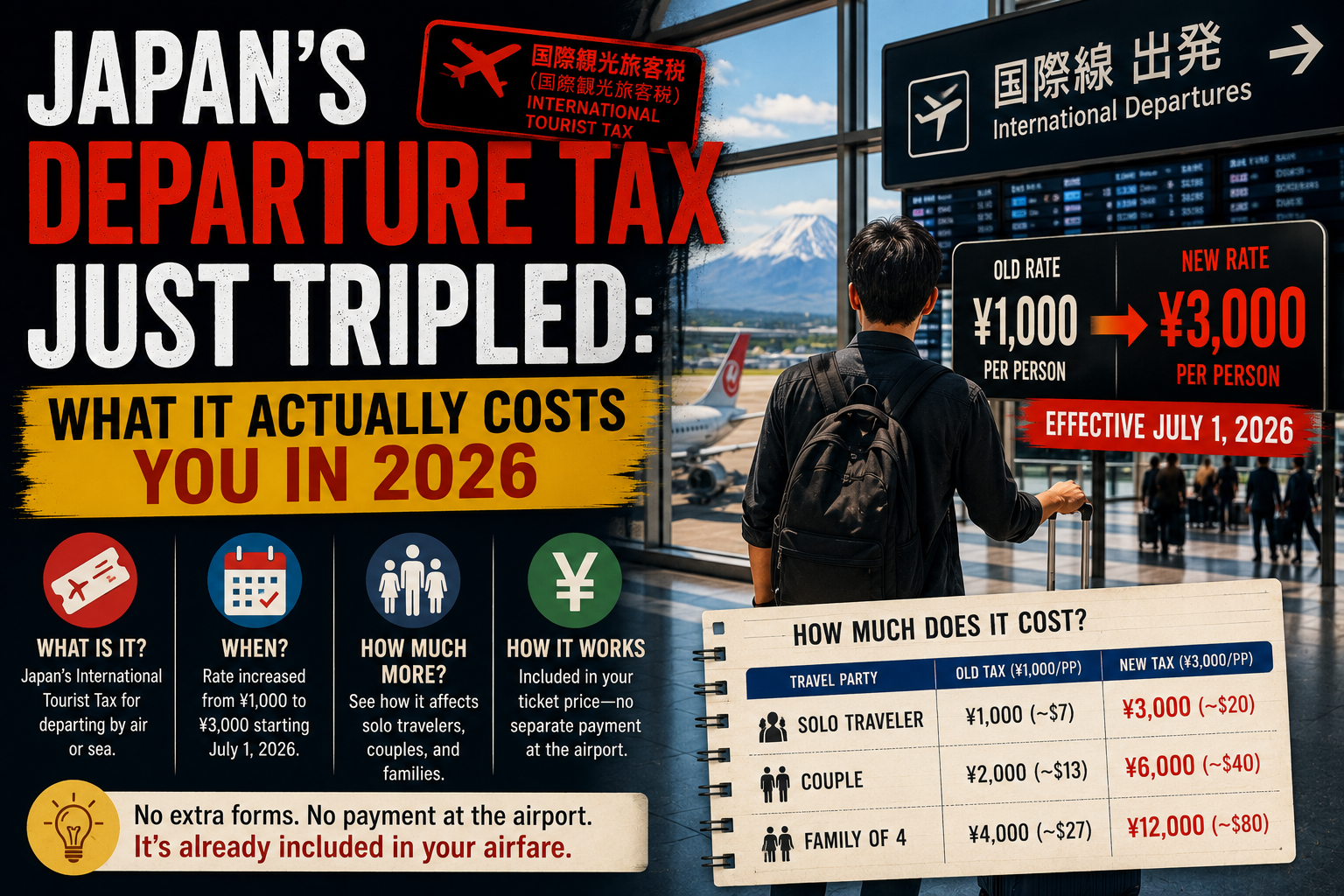
If you’re booking a flight to Japan for later this year, there’s a quiet change already baked into your ticket price. As of July 1, 2026, Japan’s international departure tax jumped from ¥1,000 to ¥3,000 per person — a full tripling, with no phase-in period. You won’t see a separate line item or pay anything extra at the airport; it’s simply folded into the price of your airfare. Here’s what actually changed, why it happened, and what it means for your travel budget.
What Exactly Changed
The tax in question is Japan’s Sayonara Tax (国際観光旅客税), officially the International Tourist Tax, charged to nearly everyone leaving Japan by air or sea, regardless of nationality. It has existed since 2019 at a flat ¥1,000 per departure. From July 1, 2026, that rate tripled to ¥3,000. The tax is collected automatically as part of your airfare or cruise fare — there’s no extra payment or action required at check-in or immigration, and no new form to fill out.

To put the increase in context: the tax was introduced in January 2019 at ¥1,000 specifically to fund tourism infrastructure ahead of an expected surge in visitors. For more than six years, the rate never moved, even as visitor numbers climbed well past pre-pandemic levels and Japan repeatedly broke its own monthly arrival records through 2025. The 2026 increase is the first adjustment since the tax was created, and government officials have framed it as catching up to that growth rather than a routine annual hike — don’t expect this to become a yearly occurrence.
How Much More Are You Actually Paying?

In isolation, ¥2,000 ($13–$14 depending on the exchange rate) per person doesn’t sound dramatic. But it adds up fast for families and groups, and it stacks on top of accommodation taxes, consumption tax, and rising hotel rates that have already made 2026 a more expensive year to visit Japan than 2023 or 2024.
It’s also worth putting this next to the bigger picture of a Japan trip budget. A typical mid-range week-long trip for two — flights, hotels, food, transport, and activities — often runs somewhere between $3,000 and $5,000 depending on season and city mix. Against that total, an extra ¥4,000 (roughly $27 combined for a couple) is genuinely a rounding error. Where it matters more is for large families, school groups, or anyone booking multiple short trips to Japan within the same year, where the per-person tax adds up across several departures.
| Travel Party | Old Tax Total (¥1,000/person) | New Tax Total (¥3,000/person) |
|---|---|---|
| Solo traveler | ¥1,000 (~$7) | ¥3,000 (~$20) |
| Couple | ¥2,000 (~$13) | ¥6,000 (~$40) |
| Family of 4 | ¥4,000 (~$27) | ¥12,000 (~$80) |
For most travelers this won’t change whether you go — but it’s a real cost to factor into your budget, especially if you’re already stacking multiple trips within the same year.
Do You Need to Do Anything Different at the Airport?
No. This is the good news buried in an otherwise fee-heavy update: you don’t need to pay this separately, carry cash for it, or present any documentation. Airlines and travel agencies build the tax directly into your ticket price at the time of booking, the same way it has worked since 2019. If you booked your flight before July 1, 2026 for travel afterward, some airlines may collect the price difference; check your airline’s fare rules if you’re unsure, but for the vast majority of travelers this is invisible. Booking early doesn’t help you avoid the increase either — it’s tied to your departure date, not your booking date, so anyone flying home after July 1, 2026 pays the new rate regardless of when the ticket was purchased.
Why Japan Tripled the Tax
Japan welcomed a record-breaking wave of international visitors in 2025 and early 2026, and the strain on infrastructure — crowded trains, overtourism at sites like Fushimi Inari and the Fuji Five Lakes, and pressure on rural transport — has become a recurring political topic. Revenue from the tourist tax is earmarked for tourism infrastructure: multilingual signage, congestion management, preservation of cultural sites, and rural tourism development. The tripling puts Japan’s departure tax more in line with other popular destinations that have raised similar fees for the same reason.
The revenue split gives a sense of priorities: a portion is directed toward multilingual wayfinding at train stations and airports, another toward managing crowding at overwhelmed sites through timed-entry systems and shuttle infrastructure, and a growing share toward promoting lesser-visited regions so that tourism spending doesn’t concentrate entirely on Tokyo, Kyoto, and Osaka. Whether the tripled tax generates enough revenue to meaningfully shift that balance is something tourism economists will be watching over the next few years, but the stated intent is to spread both visitors and infrastructure investment more evenly across the country.
How Japan’s Tax Compares Internationally
- Japan (from July 2026): ¥3,000 (~$20) per departure
- United Kingdom (Air Passenger Duty, short-haul economy): roughly £13–£16 (~$16–$20)
- France (eco-tax, varies by class and route): €2.63–€60 depending on ticket class
- New Zealand (International Visitor Levy): around NZ$100 (~$60), charged on entry rather than departure
Even after the increase, Japan’s ¥3,000 departure tax remains on the lower end globally — it’s a cost worth budgeting for, not a reason to reconsider the trip.
The comparison matters because departure and arrival taxes have become a common tool for popular destinations trying to manage tourism growth without discouraging it outright. Bali, Venice, and the Balearic Islands have all introduced similar visitor fees in recent years, generally in the same rough range as Japan’s updated rate. Seen against that backdrop, Japan’s move looks less like an outlier policy and more like the country catching up to a pattern that’s already standard practice among high-demand destinations worldwide.
Other 2026 Fees Worth Knowing About

The departure tax isn’t the only cost that’s shifted this year. A few related items worth budgeting for:
- Tokyo accommodation tax: currently ¥100–¥200 per person per night depending on room rate, exempt under ¥10,000/night. A flat 3% rate has been passed by the Tokyo Metropolitan Assembly but won’t take effect until fiscal year 2027, so it doesn’t apply to 2026 travel.
- Kyoto’s separate lodging tax: ranges from ¥200 to ¥1,000 per person per night depending on the hotel rate, applied on top of the room cost.
- Mt. Fuji climbing fee: ¥4,000 per climber, with mandatory online reservation and a hut booking required to pass the 2pm trail gate.
How to Budget for the Full Picture
Rather than tracking each fee separately, it helps to build a simple mental checklist before you finalize a Japan trip budget:
- Flights: already include the ¥3,000 departure tax — no separate line item to track
- Accommodation tax: add roughly ¥100–¥1,000 per person per night depending on your city and hotel rate
- Mt. Fuji or other activity fees: budget these individually if they’re on your itinerary, since they require advance reservation rather than being bundled automatically
- General price creep: hotel rates in peak season 2026 are running higher than in past years due to demand, so build in some buffer beyond the tax changes alone
None of these fees, individually or combined, are large enough to be a real barrier to visiting. They’re worth knowing about mainly so nothing catches you off guard when you’re finalizing a budget, not because they change the math on whether the trip is worth it.
Our Verdict — Does This Change Your Trip Planning?
Practically speaking, no. The tax increase is small relative to the total cost of an international trip to Japan, and because it’s built into your airfare automatically, there’s nothing extra to plan for logistically. Best for: travelers who like to see the full cost of a trip laid out — add roughly $13–$14 more per person to your flight cost than you would have budgeted a year ago. Bottom line: this is a budget footnote, not a reason to change your itinerary or your dates.
Frequently Asked Questions
- When did Japan’s departure tax increase take effect?
- The tax rose from ¥1,000 to ¥3,000 per person starting July 1, 2026.
- Do I need to pay the departure tax separately at the airport?
- No. It’s automatically included in the price of your airline ticket or cruise fare — no extra payment or paperwork is required.
- Does the tax apply to everyone leaving Japan?
- Yes, it applies to nearly all travelers departing by air or sea, regardless of nationality, with limited exemptions such as transit passengers and children under two. It’s a small enough sum that most travelers won’t notice it, but large enough that airlines and travel agencies have already updated their published fare breakdowns to show it separately for transparency.
- How much extra will a family of four pay?
- A family of four will now pay ¥12,000 (roughly $80) total in departure tax, up from ¥4,000 (roughly $27) before the increase.
- Is Japan’s departure tax high compared to other countries?
- No. Even after tripling, Japan’s ¥3,000 (~$20) departure tax remains lower than or comparable to similar fees in the UK, France, and New Zealand.