
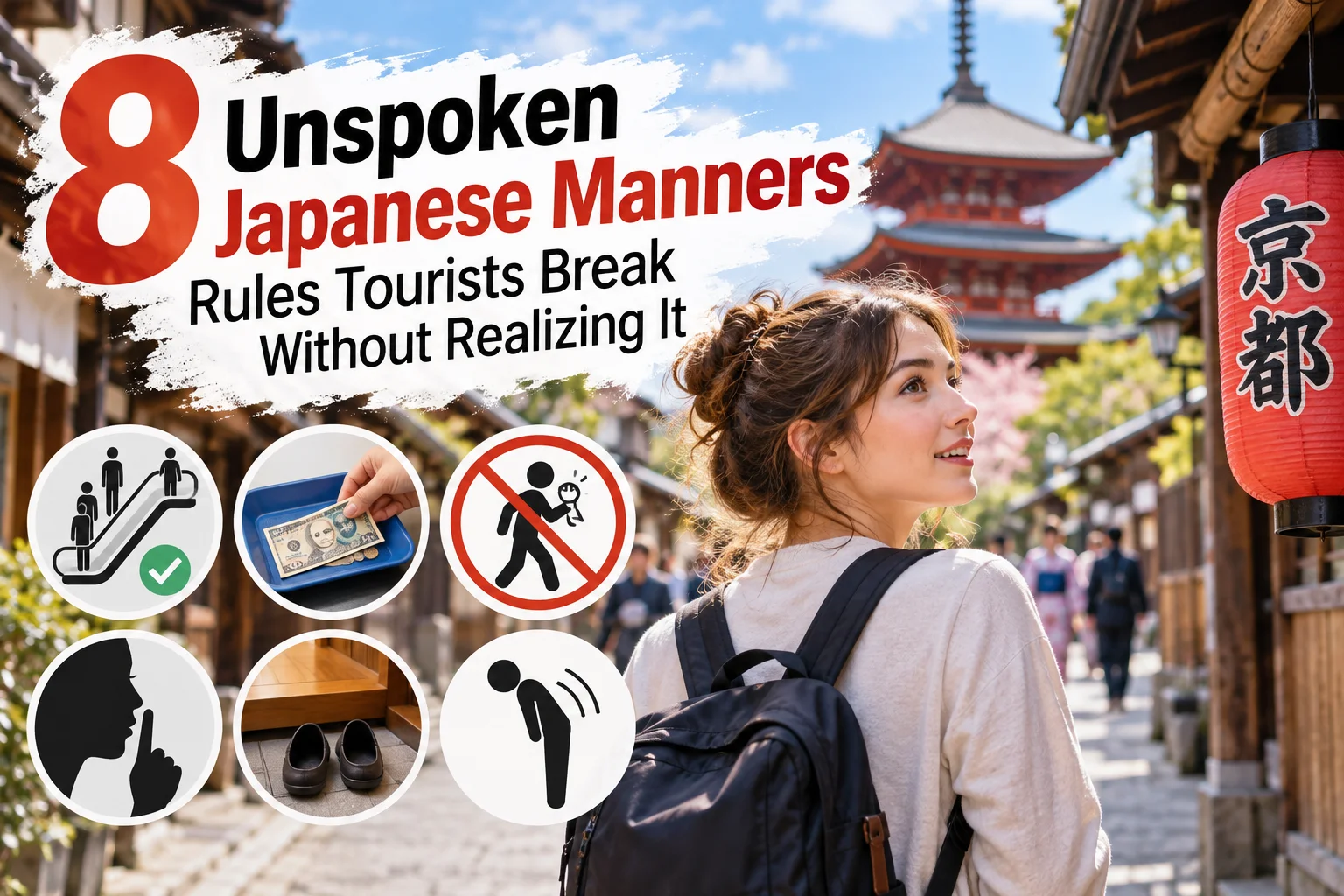
Most visitors arrive with a mental checklist: shoes off, no tipping, bow a little. Following it perfectly still isn’t enough — some of the “polite” habits people lean on hardest are the ones two entire cities have started phasing out.
The reason has nothing to do with rudeness.
⭐ Bottom Line
At least 2 of the 8 unspoken rules below are already shifting in 2026, and most guidebooks haven’t caught up yet.
- Best for: First-time visitors who want to stop drawing stares, not just avoid breaking a law
- Budget: $0 — these are behavior fixes, not purchases
- Book ahead: Nothing to book. Read this before you land, not after.
Most visitors land in Japan already knowing the basics: shoes off, no tipping, keep your voice down. Sounds simple enough. But some of the habits tourists try hardest to get right “the Japanese way” aren’t actually that simple anymore — and it’s not because anyone’s being careless.
In 2024, Japan’s Tourism Agency introduced 22 official pictograms just to explain, wordlessly, what visitors keep getting wrong. Fourteen show behavior to avoid; the rest show what to do instead. That’s a lot of formal signage for a country famous for rules nobody writes down. So which ones actually catch people off guard once they land?
Mostly not the ones travel blogs repeat every year. They’re smaller, more situational, and in a couple of cases they’re currently in flux — which means the “correct” answer a friend gave you last year might already be outdated in 2026.
Below are 8 specific etiquette habits tourists commonly get wrong without realizing it — what’s actually going on, and the easy fix for each.
1. The Escalator Side That Flips Depending on the City

Stand on the left in Tokyo. Stand on the right in Osaka. This isn’t a myth locals invented to mess with tourists — it’s a genuine, opposite-facing default between Japan’s two biggest metro areas, and it has held for decades. One popular theory ties Kanto’s left-standing habit to Edo-era samurai who carried swords on their left hip; another credits Osaka’s flipped version to the 1970 World Expo. Nobody agrees which is true, and that’s part of the problem for a first-timer trying to get it right.
The safest move as a visitor: don’t assume either rule. Glance at the platform before you step on, or simply match whoever’s ahead of you.
2. Cash Goes on a Tray, Not Into Someone’s Hand
At convenience stores, ticket counters, and most small shops, you’ll notice a small tray sitting by the register. That’s where your cash and card go — not directly into the cashier’s palm. Handing money hand-to-hand isn’t offensive exactly, but it reads as slightly brusque, and your change will almost always come back to you the same way: placed in the tray, not pressed into your hand.
3. Eating While Walking Is a Bigger Faux Pas Than Most Guides Admit

Plenty of general etiquette guides mention that eating on the move is “discouraged.” What they undersell is how location-dependent this actually is. In Kyoto’s Gion and other preserved historic districts, it’s treated as genuinely disrespectful — signs are posted, and locals will visibly react. In busy Tokyo food streets, it’s more relaxed, but still uncommon outside designated stand-and-eat spots.
4. Chopsticks Upright in Rice Isn’t Quirky — It’s a Funeral Gesture

This is one of the few rules that actually is as strict as guidebooks claim, and it’s worth repeating because the mistake is so easy to make absentmindedly. Sticking your chopsticks straight up in a bowl of rice mirrors tate-bashi, a ritual offering made to the deceased at a funeral altar. It’s not a minor faux pas like using the wrong fork — it’s the fastest way to make a table of Japanese hosts go quiet.
5. Public Transport Is a Silent Zone — Even a Hushed Phone Call Draws Stares
Texting is fine. Scrolling with headphones in is fine. Taking an actual phone call — even quietly, even briefly — is one of the more reliable ways to get pointed looks on a Japanese train. It’s not written on a sign in most cars, but it’s one of the most consistently enforced unspoken rules in the country, treated as closer to speaking loudly than to normal phone use.
There’s a specific kind of calm to a packed Tokyo commuter car at rush hour: hundreds of people standing shoulder to shoulder, and almost total silence except for the train itself. Get this rule right and you stop being the exception in that quiet — you’re just another passenger heading somewhere.
It only holds until someone’s phone actually rings out loud, which happens just often enough to make everyone visibly wince.
6. Blowing Your Nose in Public Reads Worse Than Sniffling for Hours in a Mask
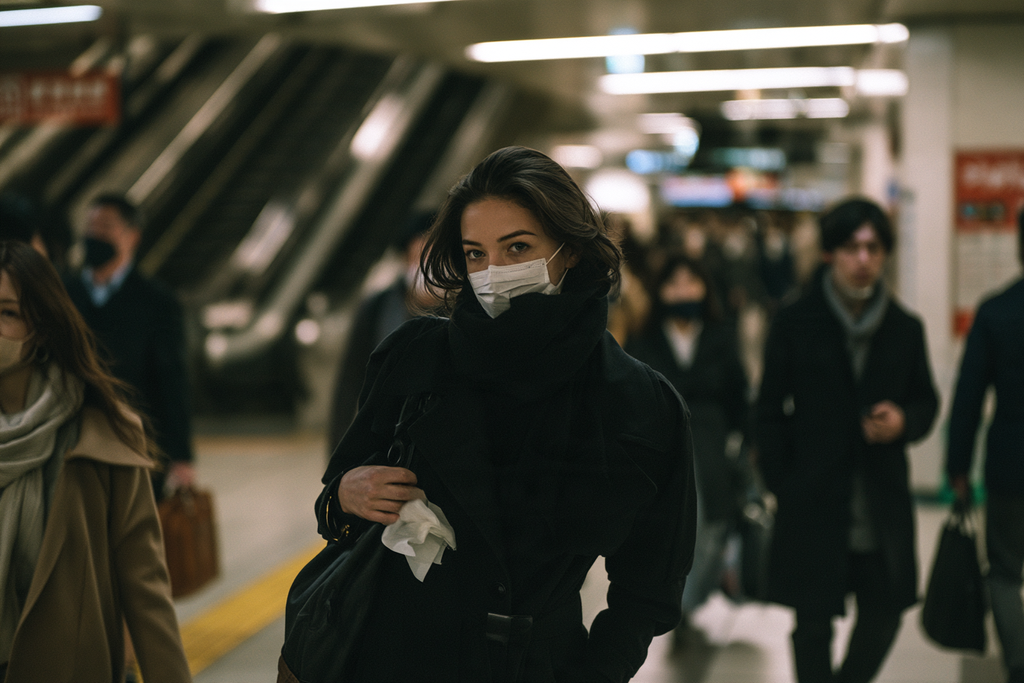
This is the rule most first-timers get backwards. Japan is a country where wearing a surgical mask while visibly sick — sniffling, coughing quietly — is completely normal and even expected as a courtesy to others. But blowing your nose openly, even into a tissue, is considered mildly gross in public. The logic isn’t arbitrary: containing germs is polite, audibly expelling them is not.
7. Trash Bins Are Genuinely Hard to Find — Carrying Garbage for an Hour Is Normal
Public trash cans largely disappeared from Japanese streets and train stations after security tightened in the 1990s, and they’ve never really come back at the same density as other countries. Streets stay remarkably clean anyway, mostly because people simply carry their trash until they find a bin — often near a vending machine — or bring it back to their hotel.
8. Women-Only Train Cars Exist for a Documented Reason, and the Wrong Car at the Wrong Hour Is More Than an Oversight
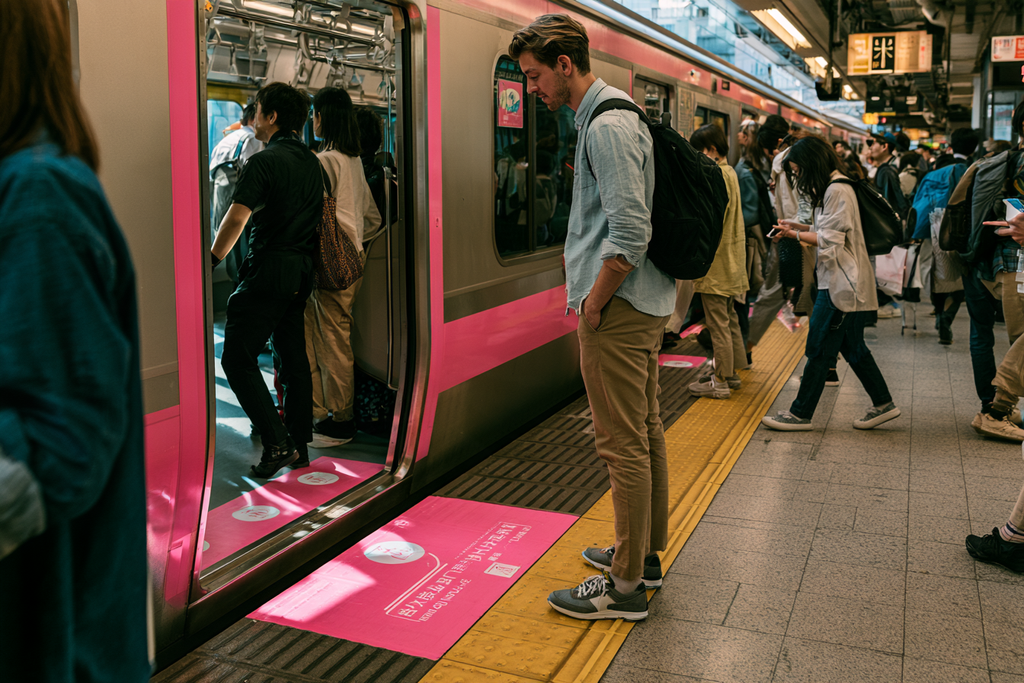
Several train operators, including JR East and Tokyo Metro, designate specific cars — usually marked in pink on the platform floor and on the train exterior — as women-only during certain rush-hour windows on certain lines. The policy exists in direct response to reported groping incidents on crowded trains, not as a quirky cultural custom.
What This Means for Your Trip
None of these eight rules will get you fined or thrown out anywhere — that’s a different, more serious list, and the consequences here are social rather than legal. But small missteps compound. A tourist who gets two or three of these wrong in the same day tends to read as inconsiderate rather than simply unfamiliar, even though the intent was never disrespect.
You don’t need to memorize all eight before you land. Most of them come down to one habit: watch what the people around you are already doing, then match it. If everyone’s standing on one side of the escalator, stand there too. If there’s a tray by the register, use it. That single instinct will get you further than reciting a checklist — and it’s the part guidebooks tend to skip in favor of longer lists of rules.
| Rule | What Tourists Usually Get Wrong | Why It Matters | The Fix |
|---|---|---|---|
| Escalator side | Assume one rule applies nationwide | Kanto and Kansai default oppositely; several cities are now discouraging walking entirely | Check the platform or match the person ahead of you |
| Paying with cash | Hand money directly to the cashier | Reads as slightly abrupt; trays are the default nationwide | Use the tray for cash, coins, and cards alike |
| Eating while walking | Treat it like festival food anywhere in Japan | Genuinely frowned upon in preservation districts like Gion | Step aside or use a standing counter |
| Chopstick placement | Rest chopsticks upright in rice out of habit | Mirrors a funeral ritual (tate-bashi) | Use the chopstick rest or lay them flat |
| Phone calls on trains | Assume a quiet call is acceptable | Treated closer to speaking loudly than to texting | Text or wait until you’ve exited the platform |
| Blowing your nose | Blow your nose openly in public | Seen as less polite than sniffling or wearing a mask | Step aside or wear a mask if congested |
| Trash disposal | Expect public bins on every block | Bins are scarce nationwide since the 1990s | Carry a small bag; use convenience stores |
| Women-only train cars | Assume the restriction is all-day or all-line | Time-limited and line-specific, tied to real safety data | Check pink floor markings during rush hour |
- Will I actually get in trouble for breaking these rules?
- No — none of the eight above carry fines or legal penalties. The consequence is social: stares, a quiet correction from staff, or an awkward moment. A separate, shorter list of rules (like drone use or oversized luggage on the bullet train) does carry real fines, but that’s a different category of mistake.
- Is it true that Osaka and Tokyo have opposite escalator rules?
- Yes, historically — Kanto (Tokyo) defaults to standing left, Kansai (Osaka, Kyoto, Kobe) defaults to standing right. As of 2026, several cities are actively discouraging the “stand on one side, walk on the other” system entirely for safety reasons, so the rule is becoming less consistent nationwide, not more.
- Can I refuse to move to a different train car if I accidentally board a women-only car?
- You should move as soon as you notice, ideally at the next stop. It’s not illegal for a man to be in one briefly by mistake, but staying after realizing reads as ignoring a clearly marked safety measure rather than a simple oversight.
- Why can’t I find a trash can anywhere in Japan?
- Public bins became scarce nationwide after security concerns in the 1990s led to their removal from many stations and streets, and the density never really recovered. Convenience stores, train station platforms near vending machines, and your hotel room are the most reliable places to dispose of trash.
- Is tipping ever appropriate in Japan?
- Almost never at restaurants, taxis, or hotels — it’s more likely to cause confusion than gratitude, and staff have been known to chase down customers to return the money. The rare exceptions are certain private guides or high-end ryokan staff, and even then a small gift is often more appropriate than cash.
Related Guides
- 7 Things That Can Now Get You Fined as a Tourist in Japan
- I Spent $4,000 on My Japan Trip and Wasted $1,200. Here’s Every Mistake I Made
- Capsule Hotels in Japan: A First-Timer’s Guide to What Actually Happens Inside
- The Hidden “Visitor Price”: Where Japan Now Charges Tourists More Than Locals
- Mount Fuji’s New Entry Rules Are Catching Climbers Off Guard